
When I was nine years old, I borrowed nearly all of the Disney How-to-Draw books from my local library up in Michigan, tracing the many characters over and over on Printer copy paper. I knew then that I wanted to be an artist, and in order to draw pictures for a living, I had to be good at it. I had grown up with animated movies on VHS from my family’s collection, but I wanted to find out how they were made. Around that time, my family bought our first family computer! Perched on a desk at the top of the stairs, I was allowed to play any of my interactive CD-ROM games, or search the internet, and the then newly established video sharing site Youtube, for anything- including the questions my parents didn’t know how to answer. Nervously, I typed out How Are Cartoons Made? into the Google search bar, and with a hesitant breath, pressed Enter. The resulting rabbit hole of search results introduced me to many overwhelming concepts, names, and ideas within the animation industry. People go to school for cartoons? Who makes cartoons? Who is Chuck Jones? How to animate? Did Walt Disney, himself, animate anything? What’s an animator? How to be an animator?
Imagine my disappointment when, during my many searches, I stumbled across Disney’s animation studio based in Florida- which at that point, had been defunct for more than three years. There was a place, where someone like me, could watch animation happen? A place where I could see the people who made my favorite characters from my favorite movies come to life on paper? Although I was upset that I had missed the opportunity to see the animation production in person at Walt Disney World, I was even more inspired to work on my artwork and become someone like them. On the 20th anniversary of Disney Feature Animation Florida studio’s closure, I wanted to write about Disney’s – and Nickelodeon’s- failed attempts to pull back the curtain on their productions at Florida theme parks!

Walt Disney Feature Animation Florida
I was born too late to truly experience the magic of the Michael Eisner era in Disney’s history, and his impact on the Disney Parks should not be understated. From establishing a partnership with Jim Henson and his Muppets to creating Disney-MGM Park (now known as Disney’s Hollywood Studios) in 1989, Eisner pushed for partnerships across brands and leaning into whatever was new, hip, and popular with the teenage-through-young-adult demographic. If Magic Kingdom is all about fairytales and nostalgia, and EPCOT is about connection across the globe and the potentials of the future, the Disney-MGM Park was a mini idealized version of Hollywood- filmmaking, stunts, and animation, all in one! The glam and glitter of film producing was still fresh in the public’s eye, and getting up close and personal with the stars (and the possibility of being filmed!) was every kid’s dream. Disney-MGM Park was built with that exact idea in mind. Riding off the wild successes of Who Framed Roger Rabbit (1988) and The Little Mermaid (1989), which had essentially saved Disney’s animation department and kick-started the Disney Renaissance of the 1990s, Eisner decided to pull the curtain back on the magic of animation to visitors attending the new park. In 1989, Walt Disney Feature Animation Florida would find its home in the The Magic of Disney Animation attraction, in the backlots of Disney-MGM Parks.

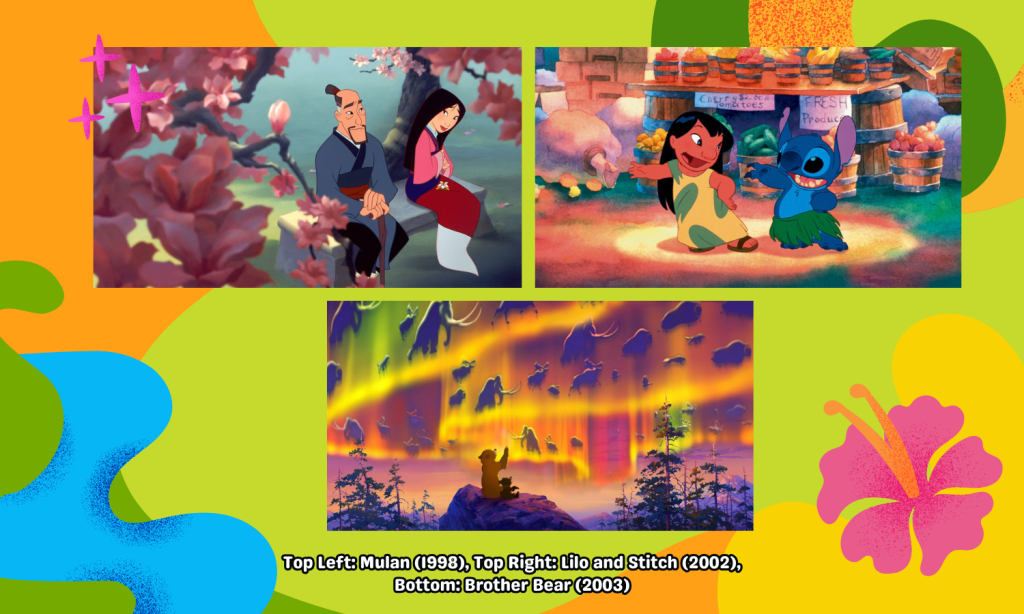
Starting with just 40 employees on opening day, the Walt Disney Feature Animation Florida (abbreviated to WDFAF for the rest of this section) would be assigned work from the main animation department at Disney in Burbank, CA, usually cleaning up shots, working on special effects, in-betweening animated segments, and producing theatrical shorts that would be played before main feature. Visitors to The Magic of Disney Animation attraction could tour the building, which included a look into the animation process as it was created, animators hunched over tables scribbling away, only separated by a thin sheet of plexiglass. Although WDFAF was primarily used as a supplementary department, helping the main studio finish content before production deadlines, the studio did solely produce some of the animated movies at the tail end of the Disney Renaissance- Mulan (1998), Lilo & Stitch (2002), and Brother Bear (2003). Although these three movies have gone on to be fan favorites (and underrated classics in the larger Disney catalogue) by 2004, the animation department at The Magic of Disney Animation attraction had been shut down. Artists and animators that had been employed around the closure were offered jobs at the main campus- in California- found other animation jobs in Florida, or formed startup animation studios. The incredibly short-lived Legacy Animation studios lasted from early February to June 2004, Magnetic Entertainment has been scrubbed off the internet, and any other startups that may have been created by former-WDFAF employees have been erased by the sands of time. So what happened? Why did WDFAF fail?
The Birth of PIXAR
If Michael Eisner was the man behind the Disney Renaissance, Jeffery Katzenburg brought in the era of computer generated images, (CGI) into the world of animation. CGI had been developing as far back as the early 1970s, but was expensive and incredibly hard to produce. Up into the early 1980s, the CGI we’ve become familiar with was solely used for short bursts of animation, for help with rotoscoping cars or other mechanical objects, or for commercials; this all changed with Lucas Computer Graphics Project’s The Adventures of André & Wally B. (1984). Lucas Computer Graphic Project would be rebranded as Pixar in 1986, with John Lasseter- the sole animator on The Adventures of André & Wally B. – being promoted to executive producer. In between commercial work and various shorts, some of which were nominated for and won Academy Awards, the technology team at Pixar worked hard to advance the software to produce a fully CGI animated film, funded by George Lucas and Steve Jobs, and other tech-forward contributors.
One of the main issues with CGI was realism- the Pixar technology could render smooth shapes, like balls and cylinders, add movement with wireframes inside the puppets, and create lighting sources, but depicting humans, hair, and realistic emotions and textures, was still beyond what the technology could handle. Yet, it was with Pixar’s third fully CGI animated short, 1988’s Academy Award winner Tin Toy, that the executives at Disney started to pay attention to the little startup studio in Emeryville, CA. The short, with features an one-man band tin toy trying to escape from a baby’s destructive grasp, would be a jumping off point for a movie pitch- what if toys became real when we’re not looking? While this “toy story” would be in production for years, eventually pitched to Disney for financial backing, the second half of Disney’s Renaissance films weren’t doing as well as their earlier counterparts. Who Framed Roger Rabbit (1988) and The Little Mermaid (1989) finally got Disney animation back into the black, after years of disappointing flops. Beauty and the Beast (1991) would be the first time Disney would actively seek out Pixar’s technology, using it to digitally ink and paint throughout production, and helping with staging and perspective during Belle and Beast’s ballroom dance scene. Now that Disney animators, and producers, became familiar with the software, they felt more comfortable working with it in future productions. Pixar was in the red, and Disney Animation could provide a boost of financial help, with some stipends. Disney would distribute the films, would get first billing, and complete ownership and control of the films and characters. Pixar, which had dumped millions of dollars into producing the software technology, would receive a mere 12.5% of ticket sales.
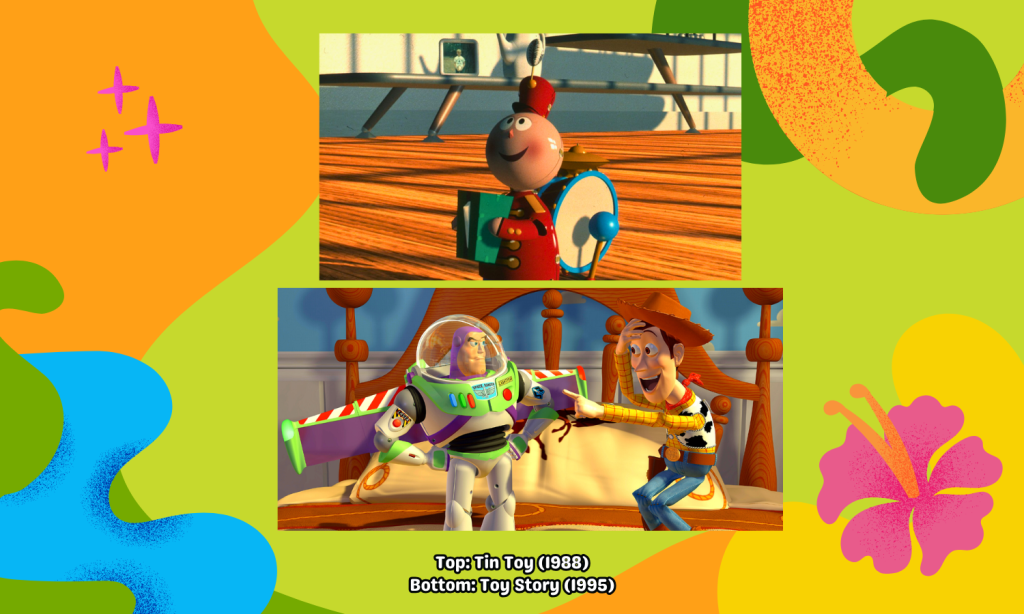
When Toy Story released to theaters in 1995, it blew Pixar and Disney’s expectations of a fully CGI animated film out of the water. It became clear to both parties that CGI, and Pixar’s advancing technologies, was in- traditionally animated movies released in that year flopped in comparison. CGI could compete against traditionally hand-drawn animation, which had been the standard for nearly a century, and Disney’s investment with Pixar paid off. Slowly, Eisner started reducing the traditional animation department at WDFAF and their television Disney Animation Australia studios, in favor of CGI integration at the main Burbank campus. CGI was new, hip, futuristic and ever advancing- traditional animation, like the behind-the-scenes attractions at Disney-MGM Parks, was old fashioned, boring. That teenage-to-young-adult demographic just weren’t interested in watching artists draw in a fishbowl. Fewer and fewer visitors to the park went to The Magic of Disney Animation attraction, and ten years later, it was shut down. At its peak, WPFAF employed around four hundred people, and had solely produced three feature-length films, four shorts, and helped produce thirteen feature-length films and one Mickey Mouse short. The industry switch from traditional animation to CGI, combined with the lack of interest from visitors, and the push away from the backstage to the franchise-focus attractions within the then-recently rebranded Hollywood Studios, meant there wasn’t really a desire (or financial reason) to continue the WDFAF branch of Disney’s Animation Studios.
Since WDFAF has been removed from The Magic of Disney Animation attraction, the building has been used for multiple purposes, like meet-and-greet with rare costumed characters, drawing instructions, exhibits of Disney artifacts pertaining to the animation industry, and showings of various Disney animated features. Hollywood Studios has evolved from a park that celebrates a film industry, the behind the scenes magic, and those who made the movies, to a hod podge of different franchises, licenses and IPs. On December 4, 2015, The Magic of Disney Animation building was replaced by Star Wars Launch Bay, and the rest is history…
Nickelodeon Studios
If you asked me what colors defined my childhood, I would say slime green and bright orange. Splashed on the television screen, Nickelodeon’s iconic splat logo was a constant in the world of children’s entertainment, the colors seared into my memory alongside commercials for Kid Cuisine’s microwaveable meals and NERF toy guns. During these rainy, cold winter days, I dream back to the summer warmth of yesteryear, and a childhood trip down to Kings Island. Before the Peanuts marketing and themed rides, Kings Island’s child friendly side of the park was all themed Nickelodeon, cashing in on the wild successes of Dora the Explorer, Blues Clues, Rugrats, The Wild Thornberries, and of course, Spongebob, all marked with Nickelodeon’s green splat logo. What remains of this temporary rebrand is the memories of those- like me- who visited the park, and any photographs taken on disposable cameras.
Meanwhile, in what felt like the other side of the world to a kid living in Michigan, was Universal Studios Florida theme park’s wildest attraction – Nickelodeon Studios. While Kings Island made the cartoons come to life in attractions, rides and meet-and-greet costumed mascots, Nickelodeon Studios allowed for kid audiences to participate in the life action shows they saw on the silver screen in person! It was a dream come true to any fan of Double Dare, Clarissa Explains It All, Legends of the Hidden Temple, All That1, and many others, chosen as a part of the live studio audience. In another attraction, visitors could take a tour of the Nickelodeon Studios, getting a sneak peak of the television production magic, from behind plexiglass windows, seeing the stars of the narrative shows rehearse and perform on set. Each tour would conclude with willing participants getting “slimed” with that iconic Nickelodeon green slime. While I never got to experience this once-in-a-lifetime attraction, hundreds of vacationers had, with the sound stages on the Universal Studios Florida park lot producing hundreds of episodes of live content from 1990 through 2005. In those fifteen years, the entertainment industry, and Nickelodeon, had changed.

The Nicktoons Era
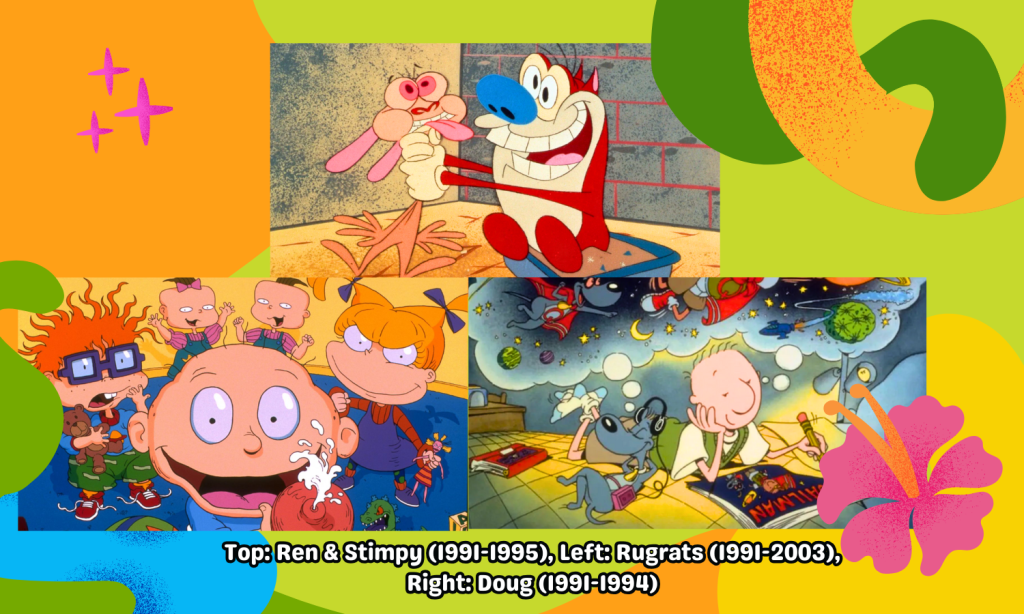
Everything changed in the world of children’s entertainment in 1991. Although Nickelodeon, the channel, had been broadcasting pre-existing cartoons since its launch in 1979, the studio was itching to get their own original IPs in the late 1980s. Vanessa Coffey, one of Nickelodeon’s talent agents, sent out a request for animated show pitches to be sent to Nickelodeon’s Los Angeles offices. Of all the applications, three shows would be produced by the Nickelodeon- Klasky Csupo’s Rugrats (1991-2004)2, Jim Jinkins’ Doug (1991-1994), and John Kricfalusi’s The Ren & Stimpy Show (1991-1995). Of the three, Ren & Stimpy became the most influential, inspiring numerous artists, animators, and writers over the past three decades.3 When Rugrats went into syndication in 1995, the cartoons began to be more popular- and more profitable- than Nickelodeon’s original live action game shows and dramas. Cartoon characters could be made into marketable plushies, shirts, hats, blankets, figurines, and more, making back (some of) the costs of producing animation, creating waves in the industry. Over the next decade, Nickelodeon would produce numerous other popular Nicktoons, such as Rocko’s Modern Life, Aaah!!! Real Monsters, Hey Arnold!, and The Wild Thornberries, in-house in Studio City, CA. In 1999, a little pilot would reach Nickelodeon’s doorstep, created by a marine biologist-turned-showrunner Stephen Hillenburg, featuring a silly yellow sponge who dreams to be a fry cook for the Krusty Krab, that pilot, of course, being Spongebob Squarepants.
Meanwhile, Nickelodeon Studios Florida’s popularity was starting to wane…
You’ve Been Slimed
What happens when you mix filming contracts, cancelled game shows, and bad weather? Universal Studios Florida found out, the hard way. Nickelodeon producers and showrunners for their live action/game show division was promised sunny, idyllic paradise Florida; instead, they got slammed with rainy weather, hurricanes, and tight outdoor filming schedules. Of course, filming a live recorded show in the middle of a theme park had its difficulties. For one, sound control. The roars and screams from folks riding the nearby rollercoasters could only be silenced so much inside the studio building, making the amplifiers inside near-deafening to the audiences.
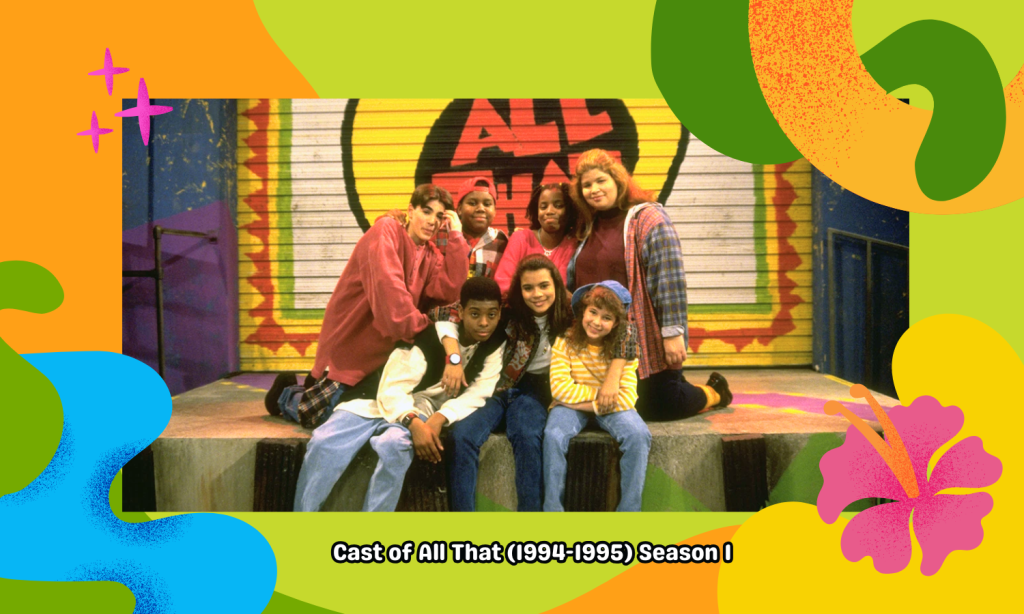
Another issue was the local talent. Nickelodeon’s more narrative driven live action shows had hired actors living in California; having to uproot child and teenage stars from their homes and friends, during most of the year and across the country, became a deal-breaker for some stars. In 1996, the creators of Nickelodeon’s most popular closed set shows of the time, All That, requested that the show be moved to California, after the first two seasons filmed in Nickelodeon Studios Florida. Nickelodeon obliged, renting out a soundstage in Hollywood, before other shows started to migrate from Florida to California. Another issue with the closed set shows was the unintentional leaking of information to the public. While the game shows were filmed in real time with a live studio audience, Nickelodeon’s closed set, narrative based shows had to be more cautious with what could be filmed during the tours. Although computers and chat boards weren’t as high tech as they are now, spoilers and plot leaking from attendees to public online forums were possible. Attendees were not required to sign NDAs for the tours, a massive foresight on Nickelodeon’s part.
In 1997 and 1998, Nickelodeon founded two studios in Burbank- Nickelodeon on Sunset and Nickelodeon Animation Studios. The former was used to film and produce many of Nickelodeon’s live action shows and game shows, with majority of the earlier shows moved from Florida. The last show to be produced on the Nickelodeon Studios Florida lot was Nickelodeon Splat! (March 7, 2004 to August 17, 2004), a short lived game show which incorporated, of course, Nickelodeon’s iconic green slime as a part of each episode.4 Nickelodeon’s animated blocks skyrocketed in ratings after the introduction of Spongebob, with other animated shows produced in house making (albeit smaller) splashes; Butch Hartman’s Fairly OddParents (2001–2017) and Danny Phantom (2004-2007), John A. Davis’ Jimmy Neutron, Boy Genius (2002–2006), Jhonen Vhasquez’s Invader Zim (2001–2006), and many others creating the second wave of Nicktoons. The era of Nickelodeon’s slime-infused game shows was over. The old Nickelodeon Studios building was converted into a Blue Man Group show, then in 2021, it was rebranded again to house the seasonal The Grinchmas Who-liday Spectacular.
Final Thoughts
Nickelodeon Studios Florida and Disney Animation Florida could not exist today with the technology we have. Anyone would love to see how their favorite show or movie is produced, but once you pull the curtain back, the magic and wonder of those numerous hows disappear. Want to learn how to draw your favorite Disney character? There’s probably a Youtube tutorial out there. Want to be on everyone’s screens? Make a viral video, and you might get your five seconds of fame on the Internet. Everything you’d ever need to know about television or movie production is easily accessed with the click of a button, from our cell phones, laptops, and televisions, from any location. Even behind-the-scenes looks for upcoming shows and movies can be viewed online or on TV documentaries, or published in coffee table art books, featuring concept art and interviews from the people who helped make the featured productions. Besides NDAs and possible spoiling of content, having actors and animators work, with a half-inch sheet of plexiglass preventing them from the audience, would never pass as safe today. The fact that there’s no reports online of harassment or verbal issues from the live audiences to the actors or artists during these attractions is either (realistically) due to cover-ups by the studios or (optimistically) it never happened. The world has become too cruel, judgmental, and dangerous to allow strangers easy access to these back stages and the many members that make up a production. Ultimately, the world has changed too much and any memories created at these attractions will have to be left in the nostalgic corners of our minds.
Check back next month – January 2025- for a very special dive into Will Vinton Studios!
Sources
http://www.wdfaf.com/tmda/index.html
The Disney Animation Renaissance: Behind the Glass at the Florida Studio
https://orlandoinformer.com/2013/nickelodeon-studios-at-universal-orlando-history-and-hopes/
Footnotes
- While official VHS exists of earlier All That episodes were accessible in the 1990s, Nickelodeon has not released an official DVD/Blu-ray release of the series. ↩︎
- Rugrats would get a continuation series in 2003 with Rugrats: All Grown Up (2003-2008), and would be rebooted with CGI animation in Rugrats (2021-2023); considered as one of Nickelodeon’s longest lasting franchises, Rugrats would also be adapted into two movies- The Rugrats Movie (1998) and Rugrats in Paris: The Movie (2000). ↩︎
- Ren and Stimpy, and John K.’s animation studio Spümcø, starred in their own Nostalgic Showcase Presents article earlier this year- check it out! ↩︎
- For fans of lost media, Nickelodeon Splat! has never gotten an official release on physical media or digital release on streaming, and only a handful of episodes of the series have been found. ↩︎


