
Summer, sometime in the early 2000s. My parents and I meet up to our local Family Video to rent some movies. We’d snag a romantic-comedy movie for them, a couple of children’s movies for me, all on VHS, and a small sugary treat. Swing over to the Little Caesars, when pizza joints had a party room with arcade machines and way too many folding tables, and finally, back home. Pizza, breadsticks, and VHS in hand, my family was set for a Friday movie night full of fun!
Except, that night was different. When I asked my parents if we could rent this one VHS, the one with “TEX AVERY SCREWBALL CLASSICS” and a wild cartoon wolf on the cover, my dad raised his eyebrow. It was far from the usual cartoons I grabbed from the shelf, but I had been a long fan of Looney Tunes and Bugs Bunny shorts- and after all, this was shelved near those! So it must be good! …Right? After some debate, my dad finally budged. After we consumed dinner and watched a movie as a family, I snuck upstairs to my parent’s room, which had a television box set with a VCR attached. I’ll never forget being wrapped up in a blanket, sitting on their bed, cherry Airheads in one hand and VCR remote in the other, watching some of the most slapstick, fast-paced, random, utterly off-the-walls energetic, and hilarious cartoons I had ever seen in my life. I might’ve been too young to fully grasp everything that these cartoons included, but I knew that by watching them, and by enjoying every minute, I was somehow crossing a line that I could never return from. Those cartoons would change how I viewed animation as a medium forever- and although Tex Avery’s cartoons rarely graced the usual Boomerang line-up of retro ‘toons from the 40s through the 70s, I had to include his works in this series! You see, summer vacation would not be complete without those Saturday Morning Cartoons, a block of new and rerun cartoons made for kids! Next up in our line-up of Summer Saturday Morning Cartoons is one of the weirdest and wackiest animation directors of the last century- TEX AVERY and his SCREWBALL CARTOONS!

Introducing… the “King of Cartoons”
Let’s start with the man of the hour- a brief introduction to Tex Avery! He was born Frederick Bean Avery, in Taylor, TX, on February 26, 1908. Not much is known about his childhood, but he was artistically inspired by Windsor McCay’s Gertie the Dinosaur, Felix the Cat cartoons by Pat Sullivan and Otto Messmer, Disney shorts, and the Fleischer Studios’ Betty Boop and Popeye cartoons. His nickname, Tex, was an affectionate reference to his birth state. He wrote comic strips while in high school, and he wanted to pursue a career in the comics industry, but fate would push him in an adjacent direction- animation. After graduating high school in 1926, Tex would enroll in a three month-long summer course at the Chicago Institute of Art, completing one month of the program and dropping out. This would be Tex’s only formal art education, but his knack for quick paced stories and expressive characters were apparent from high school. Shortly after dropping out of the Chicago Institute of Art’s summer course, Tex would move to California, which had been booming with animation studios and opportunities for up-and-coming artists. Tex would find a job as an inker1 for Winkler Studio, which produced the Oswald the Lucky Rabbit cartoons after Walt Disney and Ub Iwerks left to form Walt Disney Studios (check out NSP’s article about Disney’s failed animation studio, Laugh-O-gram Studios, here!).
Tex Avery’s Transient and Rambunctious Career
By 1929, Winkler Studio was bought up by Universal Studios, which already had the distributing rights to the Oswald the Lucky Rabbit cartoons. As a part of this merger, many of the animation workers at Winkler Studio moved to Walter Lantz Production, which continued the Oswald cartoons, rebranding and redesigning the titular character over the next five years. Tex Avery would be a part of this merger, and went from being one of the key inkers to animator, to storyboard artist and finally, directing two shorts. After a few years, Tex started to lack inspiration at Walter Lantz Productions, after numerous budget cuts and idea rejections. He was fired in spring of 1935, and later that year, Tex Avery was hired by Leon Scheslinger, whose studio would produce animated shorts for Warner Bros Studios (check out the NSP article on Leon Scheslinger Productions here!). Tex Avery would admit to lying about his experience directing shorts to Scheslinger, claiming he had more experience than he actually had, which led Scheslinger to appoint Tex to a higher position at the studio than he was prepared for. Tex took this as a challenge.
While working for Leon Scheslinger, Tex Avery was surrounded by some of the biggest names in the animation industry up to that point- Friz Freleng, Bob Clampett, Robert McKimson, Chuck Jones, and Frank Tashlin, all working within the “Termite Terrace”, a shack behind Warner Bros studio lot, assigned to the animation department that became infested with, you guessed it, termites. Tex Avery’s team would create, or help workshop, some of the most iconic Looney Tunes characters; redesigning Porky Pig to a more recognizable design, producing the first short starring Daffy Duck2 , and refining Bugs Bunny’s personality and his design, naming him after Bugs Hardaway, another animator at Termite Terrace. Tex Avery is also credited with giving the screwball rabbit his iconic tagline- “What’s up, Doc?”- a common saying in Texas. While Scheslinger was mostly hands-off with his production studio, Tex was fully hands-on, through every step of the animation pipeline, and he thrived as a director. Tex Avery was employed in the Termite Terrace for a total of five years, finishing his tenure with Scheslinger after a fight over a singular gag’s censorship, and a failed pitch. That pitch, which involved recording live animals and synchronizing funny dialogue and sound effects over it, was sold by Tex Avery to Paramount Pictures, becoming a series called “Speaking of Animals“, lasting seven years and becoming partially lost media over the years. Scheslinger fired Tex Avery in 1941.

Soon after, Tex Avery would be hired by Metro-Goldwyn-Mayer (MGM) and was assigned as head director of one of their talented animation teams. It would be here, at MGM, that Tex Avery would produce some of his most well known “screwball”3 cartoons, with nothing held back and very little censorship enforced. Higher budgets allowed more leeway with the amount of takes and exaggeration, more experimentation, and a variety cast of characters that could be pushed to the extreme. Tex Avery created even more iconic characters while employed under MGM, including Droopy, a deceptively slow-paced yet quick-witted white dog; Red, a scandalously seditious night club singer; Wolf, an excitable night club goer; George and Junior, a pair of bears whose personalities reflect Steinbeck’s Of Mice and Men‘s main characters Lennie and George4; and Screwy Squirrel, the looniest character Tex had ever created and the most disliked of the roster. Like many theatrical shorts of this period, Tex Avery’s shorts had a handful of ensemble characters and one-off characters, which didn’t have the same cultural impact as the aforementioned roster but made the shorts memorable nonetheless.

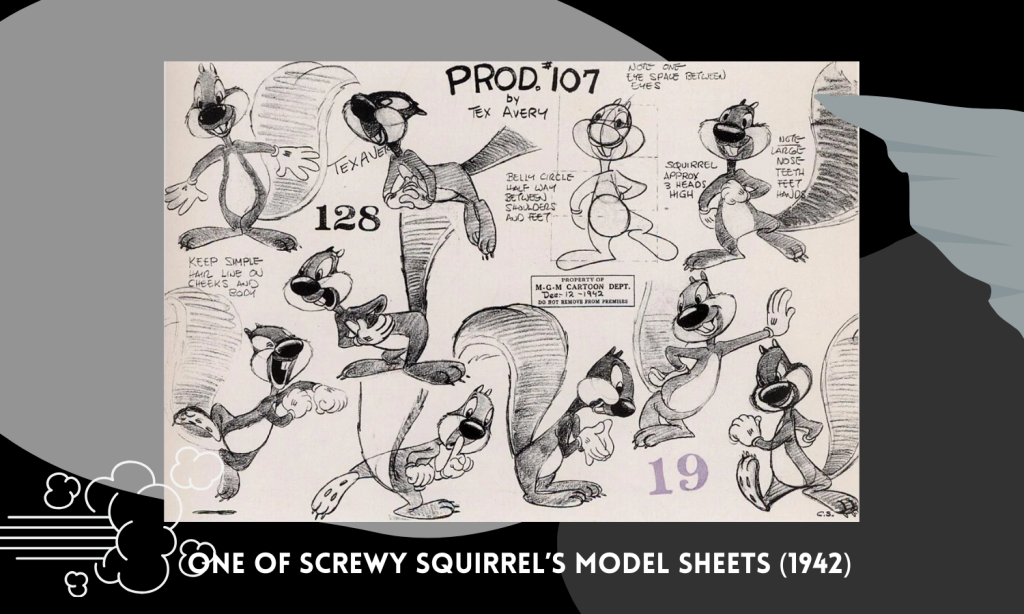
Tex Avery’s shorts at MGM had gained the title of some of the “firsts” in animation- first time the running-hallway gag5 was used; first time anvils (and pianos, and cars, and fire hydrants, and… well, you get the point) fell from the sky unexpectedly; first time the “painted tunnel” gag6 was used; first time the “defying gravity/running off the cliff” gag7 was used. All of these pre-date the other shorts that make them infamous, with the running-hallway gag becoming a staple in Hanna-Barbera’s Scooby-Doo series and the “defying gravity/running off the cliff” gag frequently being used in Warner Bros’ Wile E. Coyote and Road Runner shorts. Tex Avery’s screwball cartoons also provided their WWII audience a form of escapism- while Disney and Warner Bros created propaganda shorts for the US Government, MGM’s shorts created during the wartime avoided the topic, choosing instead to lean into more relevant commentaries through the guise of metaphors in the mainly funny animal cast, and parodies of celebrities and pop culture events.

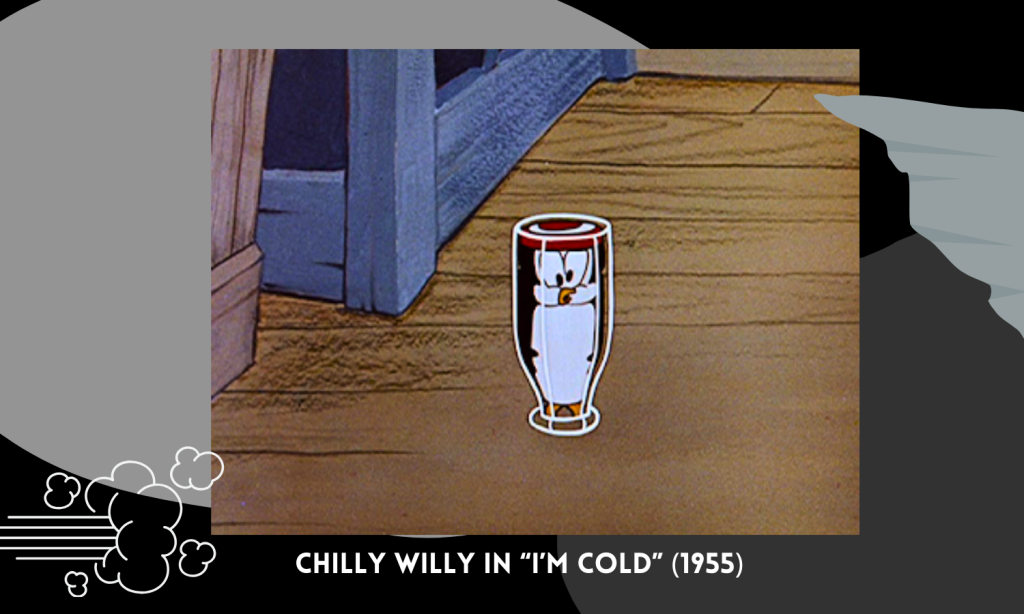
Tex’s creativity peaked and flourished while at MGM, but with so many projects in process, often overlapping each other, and with tight deadlines, burn-out was bound to happen. In 1950, Tex Avery took a short break from MGM, and started experimenting with the UPA8 animation style, but the style was too constricted for Tex and didn’t allow for as much slapstick as he wanted. Four years later, Tex left MGM to return to Walter Lantz- the studio that started his career. He was welcomed back with open arms, and Tex Avery directed four cartoons while employed there; he also established Chilly Willy the Penguin’s personality, one of Walter Lantz’s most popular characters. Yet, after just one year of working for Lantz, Tex left the studio over a salary dispute.
He left the animation industry for over twenty years, returning for advertisement work in 1979, producing animated ads for Frito-Lays chips and inspect-repellant spray Raid. During this brief return, he would also help with TV commercials featuring Bugs Bunny and the other iconic Looney Tunes characters. However, a lifetime of being an alcoholic caught up to Tex Avery. In early 1980, the veteran animator was diagnosed with liver cancer, and on August 26, 1980, after collapsing in a parking lot, Tex Avery passed away later that day.
As you can tell, his entire career in the animation industry is as quick-paced and wild as the cartoons he produced. Unlike other animators, Tex never felt compelled to stay with one studio throughout his career, instead bouncing between some of the biggest studios in the Golden Era of Animation when he felt too constrained or overtly censored or disrespected. There’s no doubt Tex Avery always had a goal in his animated shorts- and it was to push the envelope and make folks laugh. In his words, “In a cartoon, you can do anything.”
Tex Avery’s Legacy
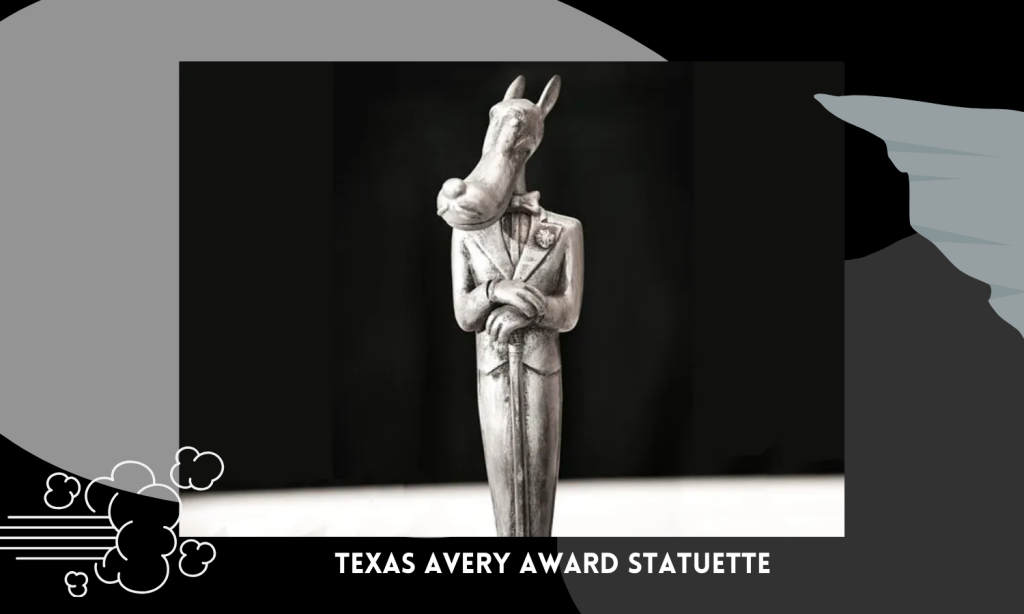
Like most artists, Tex Avery died with little recognition of his talents and expertise while he was alive. He never became a newspaper comics artist, and he didn’t earn a cent from syndication of the shorts he produced for Warner Bros, MGM, or Walter Lantz. Tex Avery’s works as an animator in the Golden Age of Animation would have been forgotten to the sands of time… if not for Robert Zemeckis’ “Who Framed Roger Rabbit?” (1988). Roger Rabbit brought Tex Avery’s creations back to the big screen, with Droopy making a special appearance during a chase scene, Jessica Rabbit being a direct reference to Tex’s “Red” character, and many of the gags in the movie acting as tribute to Tex’s shorts, released some forty years earlier. “Who Framed Roger Rabbit?” did more than bring Tex Avery’s works back into the limelight- it saved Walt Disney Studio’s animation department from being cut. But that’s another story for another article. Tex Avery was honored post-mortem with an honorary award named after him- the Texas Avery Award, which “celebrates career achievement in animation, while paying tribute to Fred “Tex” Avery – one of the most celebrated figures in the history of animation and of Dallas (TX).” (Milligan, Animation Magazine) This annual award has been given to active animators and artists in the animation industry from 2005-2015. His style, timing, stories, characters, and animated shorts inspired and continue to inspire and entertain viewers- myself included.
Join us in August in the next (and last!) segment of Summer Saturday Morning Cartoon Studios: Spümcø & STRETCH FILMS!
Disclaimer: Some of the films created in this era may depict outdated and harmful stereotypes, messages and story lines.
Tex Avery Materials
Looney Tunes Musical Masterpieces
Looney Tunes Platinum Collection Volume 2
Tex Avery: The MGM Years (SearchOhio)
Tex Avery Screwball Classics (SearchOhio); Volume 1, Volume 2
Droopy: The Complete Theatrical Collection (SearchOhio)
Tex Avery, King of Cartoons (SearchOhio)
Other Materials Mentioned
Oswald the Lucky Rabbit (1927-1928)
Scooby-Doo, Where are You! Complete Series (1969-1970) (SearchOhio)
Who Framed Roger Rabbit? (1988)
Sources
https://www.texavery.com/story/
https://www.lambiek.net/artists/a/avery_tex.htm
https://ejunkieblog.com/2020/05/05/tex-avery-when-cartoons-became-crazy
https://cartoonvibe.medium.com/tex-avery-the-animation-genius-d20cc50ec1e9
http://www.screeningthepast.com/issue-41-ronnie-scheib-dossier/tex-arcana-the-cartoons-of-tex-avery/
https://www.animationmagazine.net/2015/04/phil-lord-and-chris-miller-receive-texas-avery-award
Footnotes
- Traditional animation is created by tracing animator’s drawings from paper onto celloid sheets (or “cels”), which are then painted with colored paints from the backside and photographed in succession to create the illusion of a moving image. Ink and Paint departments were as necessary to animation studios as the animators, as the “inkers” would go through the drawings, fix any mistakes and add in-between drawings to make the animation flow better. ↩︎
- I dive into Daffy Duck’s original look and personality in Nostalgic Showcase Presents: Leon Scheslinger Productions. Daffy’s original personality was lot more wild, less focused, more violent, and more volatile, which fit Tex Avery’s comedic style. The rabbit character that Tex Avery would name – and task one of his animators with redesigning- had a similar personality to the original version of Daffy Duck, but this changed with the redesign. That rabbit would be named “Bugs Bunny”. ↩︎
- Screwball comedies, as defined by encyclopedia.com, is a film genre originating in the mid-1930s, “…Based upon the old “boy-meets-girl” formula turned topsy-turvy, it generally presented the eccentric, female-dominated courtship of an upper-class couple.” These films were marked by a strong female antiheroic lead often making fun of the male, or creating social commentary on classism, in the heteronormative relationships seen in media at the time. They started to wane in popularity during the 1940s due to the strict censorship rules enforced by Hollywood’s Production Code (1934). ↩︎
- Thanks to one of this blogs’ readers who noticed ol’ George and Junior’s absence from this article, and pointed it out to me- I didn’t mean to forget them! Thanks for reading! ↩︎
- The “running hallway” gag refers to a chase scene in which the chaser and the object of the chase are forced into a hallway, and enter and exit through various doors, crossing paths with each other, for comedic effect. ↩︎
- The “painted tunnel” gag refers to when a character, usually the antagonist, paints a tunnel on a brick wall to stop the opposite character. With toon logic, the opposite character is able to run through the painted tunnel, but the one who painted the trap cannot, and usually gets hurt as the direct result of trying to follow the opposite character. ↩︎
- The “defying gravity/running off of the cliff” gag is where a character, usually during a chase, runs off a cliff/skyscraper/etc, doesn’t realize that they’ve left the ground and floats mid-air, realization sets in, and then the character falls to the ground. ↩︎
- The UPA (United Productions of America) style is categorized by three things, all for efficiency and simplicity; lines, colors, and depth. UPA animators could thoughtfully use as few lines as possible, with the barest color palettes, and the flattest backgrounds, and still tell a captivating and entertaining story. Made popular with the wildly popular Mister Magoo series (1960-1962) and Gerald McBoing Boing (1950), which won the Oscar for Best Animated Short in 1950. ↩︎


