Two years ago, I wrote about how mental health and different diagnosis are represented in visual media, like movies and television shows. This year for our annual Health Fair I wanted to pick up where I left off, and explore how different physical and intellectual disabilities and differences are presented in different media: the good and the bad. I have listed local and national resources for those with physical and intellectual disabilities, followed by a link to our disability section at Westlake Porter Public Library.
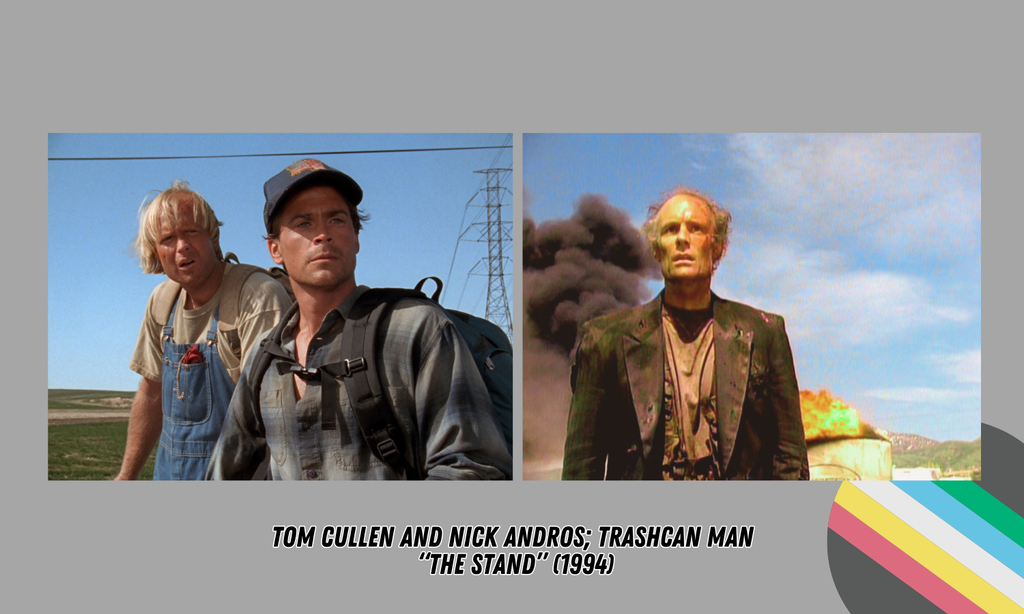
The Stand (1994)
Last month, to get into the Halloween spirit, I watched Stephen King’s mini-series, The Stand. Adapted from the book of the same name, The Stand starts with the end of the world, an apocalyptic influenza virus that wipes out 99.4% of the world’s population, and focuses on the lives and struggles of the lone survivors as they band together. Like any Stephen King story, there’s a heavy emphasis on good versus evil, with one group being called to fight the corruption of the other, and unknown, supernatural powers that may have been existed long before the virus. In the “good” group is Nick Andros, played by Rob Lowe (who is partially deaf), a deaf-mute character; and his travelling companion, Tom Cullen, played by Bill Fagerbakke, who has mild to moderate learning/intellectual disabilities. Tom is unable to read, dropping out of elementary school at a young age, and since Nick cannot speak, the pair struggle to properly communicate until a third party can read Nick’s handwritten notes. Outdated terminology is used by other characters towards both Nick and Tom, but the series makes it abundantly clear that both Nick and Tom are more intelligent and clever than they appear; in fact, their actions save or help advance the main characters and the plot of the series, but they seem to be lacking in any sort of personal agency.
On the other hand, and as a part of the “evil” group, is Donald Elbert, otherwise known by childhood nickname Trashcan Man, played by Matt Frewer. While this character is a fan favorite (and certainly sticks out in my mind as one of the best performances, despite having the least amount of screentime), Trashcan Man is written as having schizophrenia with pyromaniac tendencies, and is easily swayed to join antagonist Randall Flagg. His actions are motivated directly by his mental state and desires for explosives: when he has a schizophrenic episode, he becomes destructive and ends up being an essential part of the climax of the mini-series. While I enjoyed the series as a whole, the depiction of these mental and physical disabilities and how they’re portrayed on screen in these side characters, left more to be desired.
Flowers for Algernon (1959)
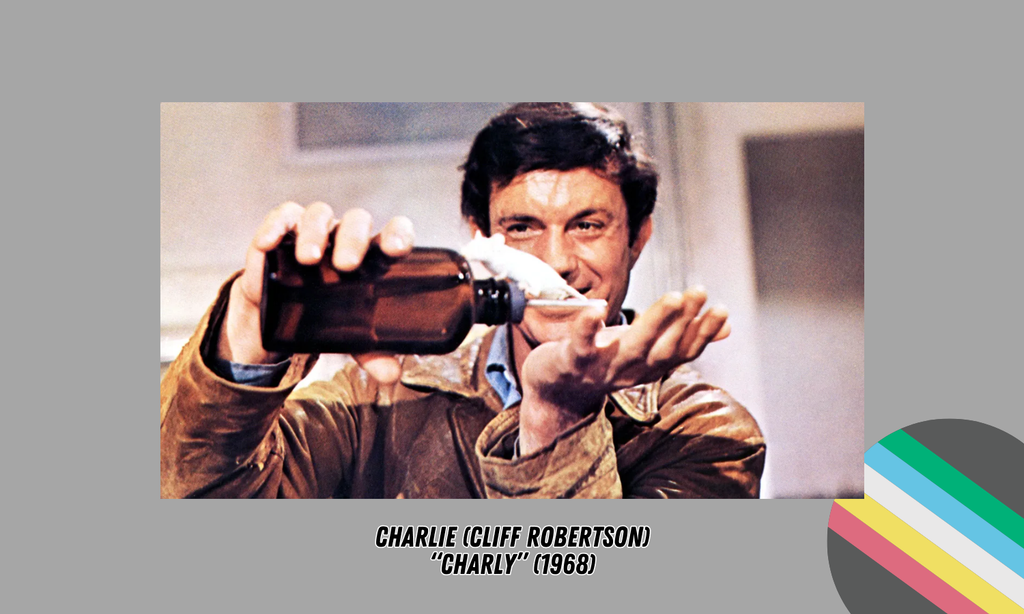
I could not write an article about characters with intellectual disabilities without including Daniel Keyes’ Flowers for Algernon. Written as a series of progress reports from the perspective of Charlie, who has a mild intellectual disability, through five months of his life, and his relationships with people and the world. A team of scientists recruit Charlie for a promising new surgery to increase his IQ, proven successful by a lab rat named Algernon, and Charlie accepts the treatment. Following the surgery, his intelligence increases dramatically, and he realizes how cruelly his co-workers and others treated him before. Charlie excels further past the IQs of his peers, and the scientists, and finds it difficult to relate to anyone, isolating himself. As Charlie realizes that the scientists conducted the surgery for their own altruistic gain, rather than to help him, Algernon starts deteriorating, eventually passing away. Soon after, Charlie starts to revert back to his original state, and the story ends with our narrator wishing, hopelessly, that someone put flowers on Algernon’s grave. Although many science-fiction stories have covered this trope (uplifting one’s intelligence for the greater good of themselves or society), none have been more poignant to me than this one. Numerous adaptations have been made for Algernon, but the one I remember watching as a teenager was Charly (1968).
Wonderstruck (2017)
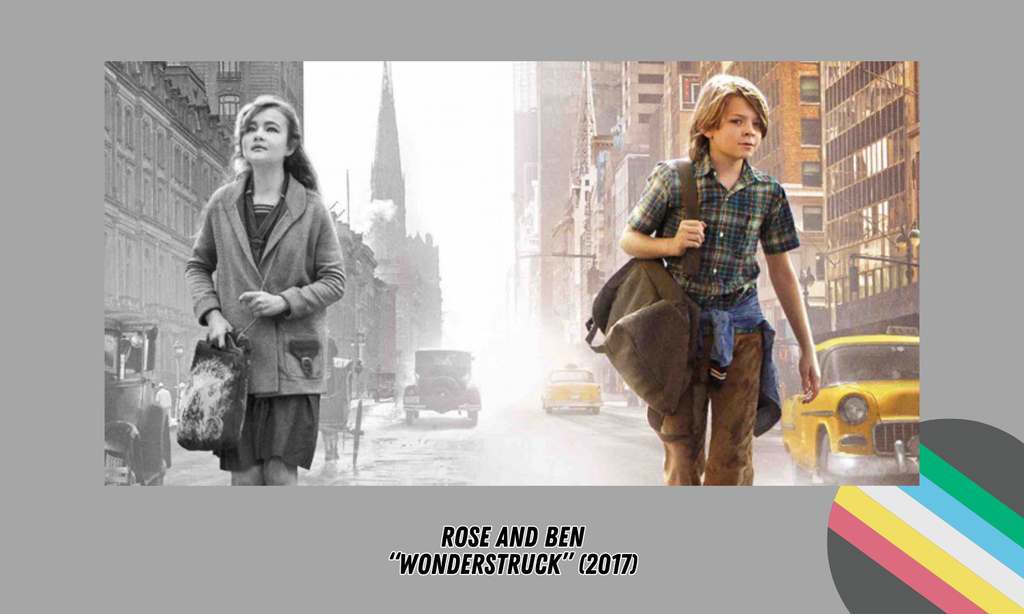
As I was writing this article, I realized that a bit of a pattern was forming: books adapted into movies! And our next pick is no exception, with modern classic, Wonderstruck. Told from the perspective of two narratives, fifty years apart, of two deaf characters as they try to search for their family members, intertwining together. In the 2017 film adaptation, Rose (played by deaf actress Millicent Simmonds) is from 1927 and trying to find actress Lillian Mayhew; in 1977, co-protagonist Ben (played by Oakes Fegley) is searching for his estranged father. In the book, the different narratives are noted in two different mediums: Rose’s in pictures, beautifully illustrated spreads of highly detailed pencil drawing artwork that tells her narration, while Ben’s sections are traditionally written, losing his sense of hearing during the story. In the movie, Rose’s scenes are filmed using similar methods used during the period of the 1920s, in black-and-white, and Ben’s scenes are filmed according to the stylistic choices of the 1970s, creating a strong contrast between the two. As both stories unfold, they start to intertwine, until both Rose and Ben meet each other at the end. Even though their shared disability are an important part of the story, the primary focus is of communication, connection, and shared experiences across generations.
The Hunchback of Notre Dame (1996) and The Goonies (1985)
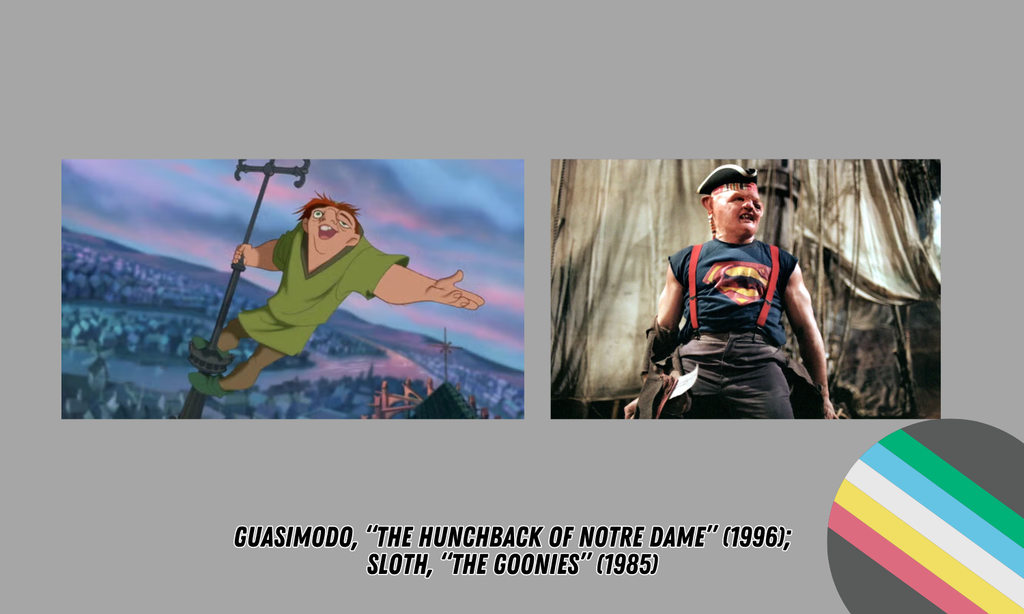
The depiction of characters with mental and physical differences has improved greatly within the mediums of the written text and through visual media, but it would be amiss of me not to address the elephant in the room: the trope of associating physical disabilities with villainous or “monstrous” characters. As I was conducting my own research for this article, I thought back to a childhood favorite- Disney’s The Hunchback of Notre Dame. The titular character, Quasimodo, is a hunchback with facial and bodily deformities, and although it isn’t fully explored in the animated adaptation, is partially deaf in his characterization in the original Victor Hugo novel. Throughout the film, Quasimodo is isolated and ostracized for his appearance, an idea which is reiterated numerous times by his caregiver/antagonist Frollo, who imprisons him in the bell tower. Only when a kind, Romani woman named Esmeralda takes pity on him does he realize that the civilization below the bell tower could be welcoming or even, loving, towards him. Both characters are outcasted from society, either because of their social standing or physical appearance. The end of the film leaves Quasimodo exactly where he was at the beginning; back at the bell tower, but now with an allyship and friendship with Esmeralda and her love interest, Phoebus, and a new-found sense of his place in society.
I can’t help, then, to compare this portrayal to another favorite from my childhood: Sloth from The Goonies (1985). Similarly to Quasimodo, Sloth has been isolated and imprisoned from society, is portrayed as scary and monstrous by others, and it takes an outside force (Esmeralda/Chuck, one of the kids from The Goonies) to free the physically disabled character from their bonds. Sloth’s disabilities expand past his physical appearance, portrayed with unidentified developmental and speech delays, yet has upper body strength (similar to Quasimodo, who needs near inhuman strength to pull the ropes to ring the bells; Sloth pulls bolted down chains handcuffed to his wrists, and pulls sewer pipes out of place with ease) and towers over pre-teen Chuck. Even though Chuck is apprehensive around Sloth and even fears him at the beginning, he learns to communicate with him, and the pair become friends while they try to navigate through the underground systems to catch up to the rest of the cast. Sloth’s biological family is also abusive, both verbally and physically, towards each other and him; with Chuck, Sloth is able to experience kindness and warmth from another human, and eventually, fights off his own family members to help the rest of the Goonies escape. As a kid this wasn’t something I focused on, but I can see how this type of portrayal and storyline can be detrimental both to the individual and those who are not afflicted with similar disabilities.
Wonder (2017)
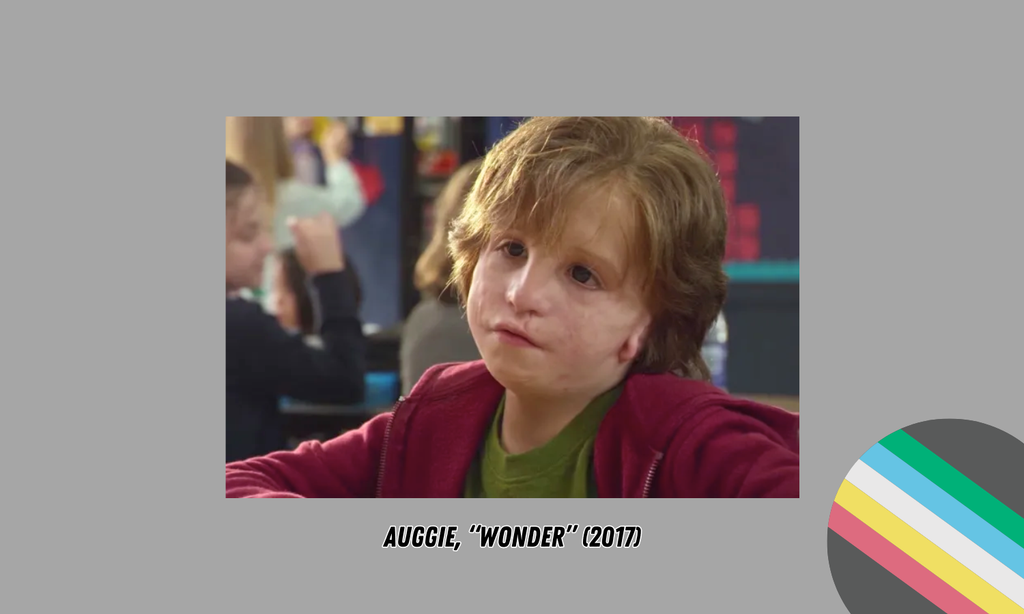
Back to a more contemporary pick, with 2017’s Wonder. Based on an award-winning juvenile book by R. J. Palacio, Wonder is about a young boy named Auggie (played by Jacob Tremblay) who returns to public school after being homeschooled, born with a significant facial difference (specifically, Treacher Collins syndrome) which has caused him to have numerous surgeries since he was born. He wants to go to school and to be surrounded by kids his own age, although at first, many do not understand his condition or are fearful of his appearance, and the story is a year in the life of our main character. The movie adaptation follows the book closely: Auggie returns to school, faces bullies who target him because of his facial differences, finds solidarity with friends, confronts the bullies, and then, Auggie is rewarded at the end of the school year for his strength and courage throughout the school year. The other picks from this list had some sort of fantastical, science fiction, or otherworldly elements to them, but Wonder is squarely placed in reality, struggles that those with any sort of differences (physical, mental, or otherwise) can relate to. The book continues to be a popular pick with our elementary readers.
Last Remarks
For my last remarks for this article share similar sentiments from my previous article. People with developmental, intellectual, and mental disorders have been fighting for better representation on the screen, an uphill battle, over the past two decades. Despite these efforts, there does seem to be a fear of body dysmorphia, amplified by body differences, deformities, and disabilities, and the portrayal of these differences continue to be associated with “scary” characters to this day. DC’s Clayface (2026) is a body horror film that came out in theaters this year, centered on a character who gets disfigured during an accident, receives a treatment that amplifies his body differences, eventually leading to a murderous rampage. Social media influencers with facial differences panned the film for furthering this trope, citing the film’s implications that the deformities are the reason behind the character’s nefarious actions. Characters with intellectual or developmental disabilities are harder to find in modern films or shows, and when they are included in the story, these characters are typically performed with those who do not have the disability. Those who have physical disabilities or differences, then, have to wear special effects make-up or prosthetics, or computer generated imagery is applied in post production, to achieve the right look. I struggled to find characters that were blind, being portrayed by blind or limited eyesight actors. Of the five shows/movies featured in this article, only two actors had a disability close to their character: Rob Lowe and Millicent Simmonds. Rob Lowe has been completely deaf in his right ear since he was a baby, and took his personal experiences in account while playing Nick Andros in The Stand; Millicent Simmonds, who has been completely deaf since birth, played a character in Wonderstruck who is constantly facing realistic barriers because of her disability in the film. For each film that portrays these conditions “right”, there’s a handful more that convey negative tropes, stereotypes, and tired storylines, or worse, depict those with physical or developmental disabilities as unintelligent or unworthy of community. Another issue that I continued to face while working on this article, and the last one, is that characters with disabilities are more likely to be men, across the board; between this article and the last one, only five of the fifteen films or shows featured women as the lead or close secondary main character with a disability, with majority of those five being contemporary releases within the last two decades. All characters that came up were Caucasian or white. And yet, disabilities and differences do not discriminate, and just as with mental health, these conditions can affect anyone.
Film has the power to change our perspectives and how we treat others. I hope this article has helped dispel some myths about physical and developmental disabilities and its depictions in media, and hopefully inspire young filmmakers to create better films and characters with disabilities in the future. Have a great Health Fair!
Disclaimer: Some of the films created in this era may depict outdated and harmful stereotypes, outdated diagnosis names, treatments and depictions of developmental/physical/mental disorders, messages and story lines.
Resources
Check out Westlake Porter Public Library’s Disability Resources Collection, and our monthly selection of Disability programs!