
Every single animation student, perhaps around the globe, has to purchase a copy of Richard Williams’ guidebook, The Animator’s Survival Guide. Half full of handwritten notes and drawings, a quarter of tutorials of the most basic animation practices to the most advanced walk cycles and expressions, and the rest pulling from his own experiences in the industry, from independent commercial works to working directly with director Robert Zemeckis on Who Framed Roger Rabbit (1988), the guidebook is a reference bible for anyone learning this artistic craft. Williams had a knack for teaching new artists how to breathe life into their drawings through animation, and his pursuit of perfection in timing, craftsmanship and skill is honorable, nearly four decades of experiences funneled into one extensive book. The edition I bought in my first year of art school was a beat-up secondhand copy- it was all I could budget for- and despite every dog eared page, underlined word, and highlighted section from it’s previous owner, The Animator’s Survival Guide continues to be one of my most cherished books from my college years. It was a few months after I purchased this copy that I learned that its author passed away, and of the full impact of his lifelong career, impact on the animation industry, and his legacy. Now, six years later, I return to bring to you the last edition of Nostalgic Showcase Presents for 2025, on Richard Williams’ life and legacy, and the works produced by his studio, Richard Williams Animations!
Snow White, Disney, and Williams’ Early Career
Richard Williams was born in Toronto, Canada on March 19, 1933; his mother, an illustrator, was at some point offered a position to work for Walt Disney Studios. When Williams was five, Disney’s Snow White and the Seven Dwarves (1937) premiered in theaters in Toronto, and the animation immediately hooked Williams. In one interview, he recalls, “She took me to see Snow White when I was five and said that I was never the same again. Not that I was scared like all the other children who thought the creatures were real… I knew they were drawings, and that’s what fascinated me.” It became his childhood dream to become an animator for Disney, and when he was fifteen, Williams took a bus from Toronto to Los Angeles to visit the studio and get some advice. As a publicity stunt by the studio, Williams was allowed access into the building to learn the animation production pipeline for two days, ending with animation director Dick Kelsey telling Williams, perhaps, the most important advice of his career- “Forget animation, go learn to draw.”

Shortly after Williams’ visit to Disney Studios, he visited an art gallery exhibiting Rembrandt paintings. Surrounded by Rembrandt paintings, Williams was inspired to make fine arts, studying both drawing and painting at the Ontario College of Art. For two years, he moved to the Spanish island of Ibiza, making money selling his paintings and playing jazz music. Eventually, he grew bored of painting, drawing up storyboards for a short animated film about three idealists in his spare time, and moved to London. Williams was quick to pick up commercial jobs in the animation industry, working for various small animation studios, funding his short film, which would take three and a half years to make- the BAFTA-winning The Little Island (1958). Following the success of that short, Williams was hired to work at TV Cartoons in London, which had been operated under UPA for TV commercial works; when UPA retreated, the studio was handed over to George Dunning. In 1962, Williams would form his own independent animation studio- Richard Williams Animation.
Animated Titles and Studio Classes
Williams had already made numerous connections in the animation industry both in England and in the USA by the mid-60s, and had become close with Chuck Jones. While Williams was working on the highly detailed animated titles and inter scenes for 1968’s The Charge of the Light Brigade, animating political cartoons into moving pictures, he reached out to Ken Harris- one of Chuck Jones’ best animators. Harris would travel from Los Angeles to London to meet with Williams, and the pair started working on a concept, an adaption of 1001 Arabian Nights. Williams eventually convinced Harris and his wife to move to London, and the pair started work on The Thief and the Cobbler, the adaptation, soon after.
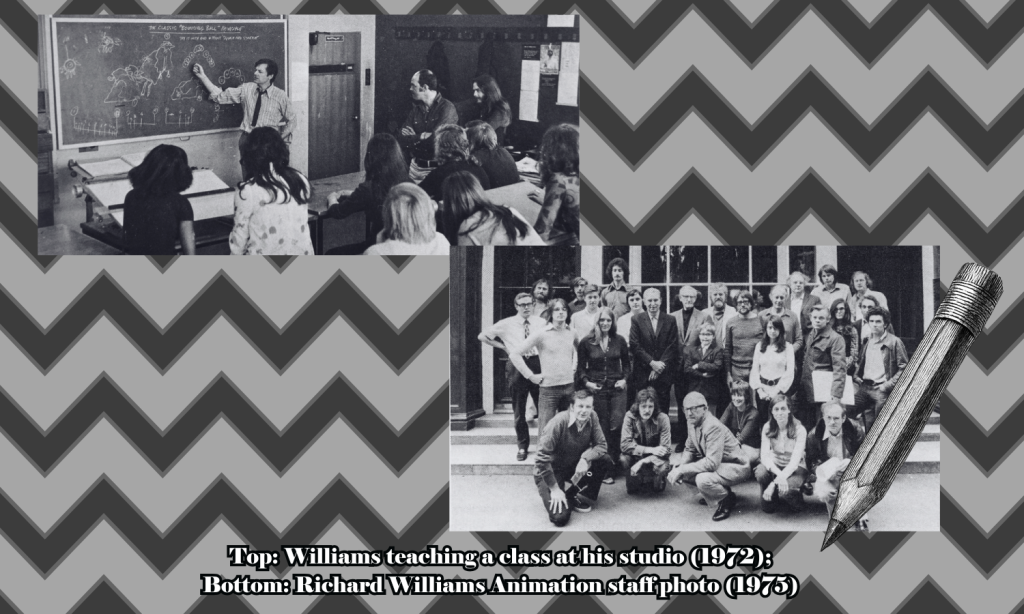
Meanwhile, Williams and his studio continued to pick up hundreds of commercial jobs from Heinz to Kellogg’s Frosted Flakes to Fanta and many others, spanning a variety of different art styles, clients, and products. As more advanced and older animators retired from bigger studios, Williams hired them into his studio, new animators working alongside legends like Art Babbit (creator of Goofy for Disney) and Grim Natwick (designer of Betty Boop for Fleischer Studios, lead animator for Snow White for Disney). These animators would occasionally lead classes on animation as per Williams’ request, continuing education inside the studio and fostering an environment where creativity and personal artistic strengths grew wildly. In 1971, the studio produced the Emmy-winning special, A Christmas Carol, with art direction inspired by the original 1843 engraved illustrations. A few years later, in 1975, Williams animated the titles for Blake Edwards’ The Return of the Pink Panther, and again, in 1976, for The Pink Panther Strikes Again (the fourth and fifth film of the Pink Panther series, respectively). In 1977, Williams’ animation studio created their first full length animated feature, Raggedy Ann & Andy: A Musical Adventure, loosely based on the 1924 novel, Raggedy Ann and Andy and the Camel with the Wrinkled Knees. In 1982, Williams would earn his second Emmy for a Christmas special, Ziggy’s Gift, based on the popular Those Characters from Cleveland franchise, Ziggy.
With every commercial, every special, and every short, Williams set aside a portion of proceeds to go towards The Thief and the Cobbler, which had gone over budget numerous times, due in part to the mere scale of the project, with each frame (24 per second) a unique drawing. Williams and Harris wanted the concept to be perfect, and numerous shots would be redrawn numerous times to get aspects right; one scene, in which the main villain swipes a hand of cards between his fingers, had been worked on by Williams over the course of a year but lasts just twenty-one seconds total. This commitment to perfection would led to The Thief and the Cobbler unraveling into the longest production of an animated film with an unbreakable 28 years… and the released version is far from what Williams and Harris dreamt up back in the early ’70s. But we’ll return to what happened with The Thief and the Cobbler later in this article.
Toon Rabbits, a Stolen Film, and the Guidebook
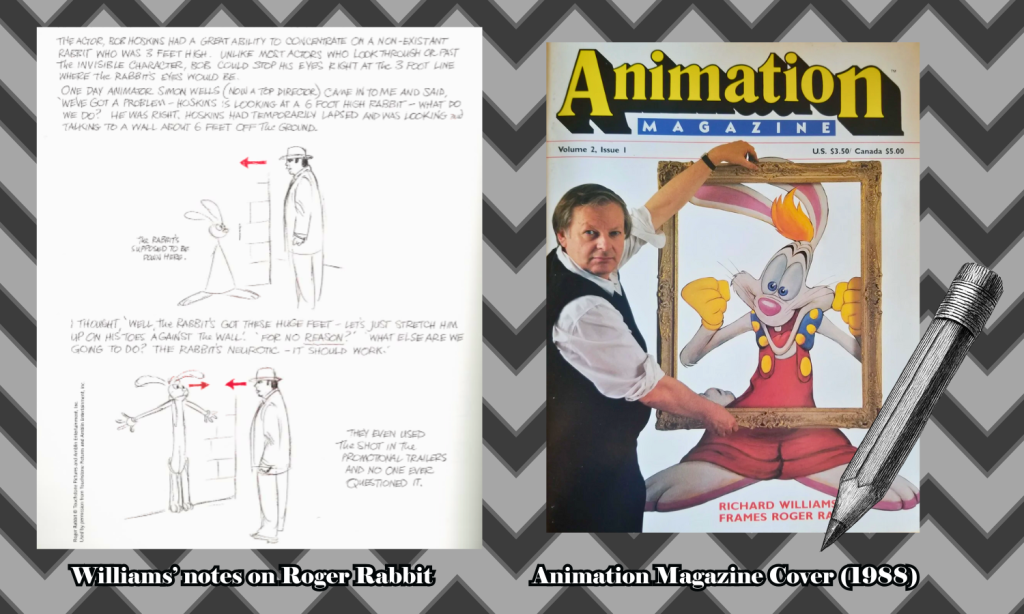
It was because of the long production and dedication to The Thief and the Cobbler that Williams was asked to be the animation director for a little live action/animation project that had been picked up at Disney. He originally denied the role, but executives at Disney offered Williams to distribute his passion project once finished- a once-in-a-lifetime opportunity he couldn’t refuse, in exchange for his work on their film. Obviously, Williams took the deal, and animation started production on Who Framed Roger Rabbit? Williams’ animation team was moved to The Forum in London, with live action portions filmed in a studio lot at Elstree Studios in Hertfordshire and exterior shots filmed at numerous locations in Hollywood. To paint the illusion that the cartoons lived in the same world as the live action actors, each frame of film was expanded, animated on, and special effects were tediously and meticulously added both in the lighting of the characters and any physical objects the cartoons interacted with. Eye lines between cartoons and live action actors needed to be perfect, as any shortcuts or wavering in height would have broken the illusion, and taken the viewer out of the experience. Williams created and designed Jessica Rabbit, one of the most iconic animated characters from the movie, and animated many of the shots of Baby Herman. Both director Robert Zemeckis and producer Steven Spielberg visited Williams’ animation unit regularly, both to check on the process of shots and to make sure production was running smoothly. Unfortunately, Williams commitment to perfection caused numerous shots to be redone completely numerous times, pushing back production, and raising budget costs. Originally budgeted for $30 million, which at that cost would’ve made the film the most expensive animated film at the time to have ever been made, when the animation finally wrapped production the final cost ended up closer to $50.6 million. Despite the costs, and three long years of development, Who Framed Roger Rabbit became a sensational hit, spearheading the Disney Renaissance in 1988 and revitalizing interest in the Golden Era of Animation, being nominated for forty-six awards and winning twenty-four. Williams’ work as the animation director would be honored with a Special Achievement Academy Award.
After Who Framed Roger Rabbit, Williams dedicated his full time and energy on The Thief and the Cobbler, but yet again, production lagged behind. As a result, Disney backed out of the distribution deal, focusing on their own animation studio which had been working on The Little Mermaid, and Spielberg focused his attention on his own, short-lived animation studio, Amblimation. Instead, Williams pitched the film, including the produced animation reel, to Warner Bros, who agreed to handle distribution and gave Williams control over production. The cut of the film at this stage was three hours long, but most of the produced animation was a series of sequences pasted together with a mere suggestion of a plot. For the next few years, under a strict 1991 deadline, Williams recruited a number of animators but was demanding and strict. Often, animators had to work around the clock to get shots done, sometimes with sixty-hour work shifts. Around this time, the finalized designs of the main cast was finally decided and Williams famously wrote the film on the cuff, with no or very little pre-planning or storyboarding (an unheard of practice in feature film animation), causing more setbacks. By 1992, a year after the deadline, Williams showed Warner Bros a cut of the film- but with major plot scenes unproduced and asking for another six months to produce 10-15 minutes of animation to complete the already over-budget film, Warner Bros dropped out of the deal. Instead, Completion Bond Company seized control of the film in its entirely, ousting Richard Williams and his animation team, and hiring Fred Calvert to edit the film and to make any additional animation to fill any plot holes. The animation production itself was outsourced to numerous studios across the globe, with a visual decline in quality seen in these additional scenes. This new version of the film was re-edited to a musical, and distributed by Miramax, in 1995, with a mere whimper. The same year he lost The Thief and the Cobbler, Williams’ animation studio closed.

With his passion project ripped from his hands and without a studio to direct, Williams refocused onto his second biggest passion: education. Using his experiences bringing in the older generation of animators into the studio to teach hands-on classes, and his own experiences in the industry, Williams created 2001’s The Animator’s Survival Guide. The handbook, which would include DVDs of in-person demonstrations and animations in later editions, would be a compilation worth its weight in gold for any animation student, young or old. Williams applied his book to in-person physical classes, and was given a studio within Aardman Animation to work on his projects in his twilight years. In 2013, Williams and his wife, Imogen Sutton, premiered a restored cut of The Thief and the Cobbler, the version Williams had been working on before the Completion Bond Company took the film, presented by the Academy Museum of Moving Pictures. In 2016, this version of the film would be shown at the Museum of Modern Art in Manhattan; this would be the final time Williams would acknowledge the film publicly.
Prologue, Will I Live to Finish This? and Last Thoughts
In one interview, Williams, sometime in his late 70s, recalls that “I spent years trying to master (animation) and I finally got it… I think it was only 4 years ago.” Always the perfectionist, his took his lifelong love for the visual arts and applied crosshatching, careful shading and delicate linework to a shelved project- one he had dreamt of as a fifteen year old: an animated adaptation of Lysistrata by Aristophanes in multiple parts. The first part, the six-minute-long Prologue (2016), took the animator three or four years to produce, an incredible masterpiece of technological feat and just a mere glimpse into the bigger, more ambitious part of the project- a full feature movie Williams’ jokingly called “Will I Live to Finish This?” Prologue, similarly to The Thief and the Cobbler and Who Framed Roger Rabbit, was produced with each frame a unique and craftly perfected drawing, each drawn by Williams, with very little assistance from his wife, of one continuous shot of animation. Will I Live to Finish This? lived up to its temporary title- Richard Williams passed away on August 16, 2019, leaving the film forever unfinished, halted mid-production, unreleased to the public. In 2024, Sutton, published her late husband’s post humorous autobiography Adventures in Animation: How I Learned Who I Learned From and What I Did with It, adding notes and finishing later chapters about his career and life. Dozens of documentaries and specials have been made about Richard Williams and the production of The Thief and the Cobbler over the past five decades, his animated direction making Who Framed Roger Rabbit one of the best Disney films ever released, and his legacy forever moving forward with The Animator’s Survival Guide, one animated walk cycle at a time. From the moment he watched Snow White as a kid to the very day he died, Williams created art; his words ring as true now as they did from a 2002 interview: “Do it for the love of it; that’s all there is.”
As always, I hope you had as fun of a time reading this article as I did researching and writing it for you! This series has been a fun ride, a way to share my passion for animation and film history with you, dear reader, and have given me numerous opportunities to connect with numerous members of WPPL’s community both online and at our in-person events. Next year will look a lot different for Nostalgic Showcase Presents, which I’ll announce in full detail in next month’s issue, in a twelve-month-long showcase of some of the most iconic pop culture legacy anniversaries alongside USA’s 250th anniversary. Have a great holiday season, and I’ll see you next year!

Sources
https://www.onehugeeye.com/richard-williams/
https://www.theguardian.com/film/2013/apr/19/richard-williams-master-animation
https://pullingarabbitoutofahat.com/london-calling/richard-williams-animation-13-soho-square/
https://quickdrawanimation.ca/discover/monday-shorts/richard-williams-prologue
https://vodzilla.co/blog/features/prologue-an-oscar-nominated-short/
https://movemadly.substack.com/p/richard-williams-imogen-sutton-and


