Nostalgic Showcase Presents is joining in on the 250th birthday celebration of the United States of America with our own yearlong landmark celebrations of our favorite toys, movies, characters, and franchises! Check back every two months for a special themed article, and attend our in-person events throughout the year.
(As a rule of thumb for this article, I have decided to exclude any sequels, series entries, or remakes of previous films, including animation. I would love to include all the films that have landmark anniversaries this year, but, this article is long enough as it is. I’ve also made an effort to include movies that are of cultural interest, impact, or otherwise, importance. Check out our previous article on Animated Anniversaries for more films!)
We continue with moving pictures in this article, from the television screen to the silver screen. Ever since people could take photographs, there have been experiments to move the pictures in a sequential order, telling a story or otherwise entertaining audiences. Different attempts at perfecting a film camera and projector were made across various continents, although the main innovators were located in France, England, Germany, and the United States. Those earliest moving pictures, the ones that remain viewable to this day, give us an insight into the society from the turn of the century, the 1890s into the 1900s, but quickly went from experimental snapshots to fully realized short narrative stories, many adapting popular works of prose. These early years of film were not dependent on advertisers, appealing to major audiences, or following guidelines: they didn’t exist yet. Yet, with the rapid exposure (pun intended) of film technologies, mass market approval would come. Short films would be shown in penny arcade machines in boardwalks, and by the 1910s, vaudeville theaters were retrofitted with sheets and projector units, and cheaply constructed Nickelodeon theaters, named after the nickel fee for admission, played documentaries, news reels, and cartoons. The earliest films were produced on nitrate film stock, a highly flammable material, causing many early films to be lost to time.
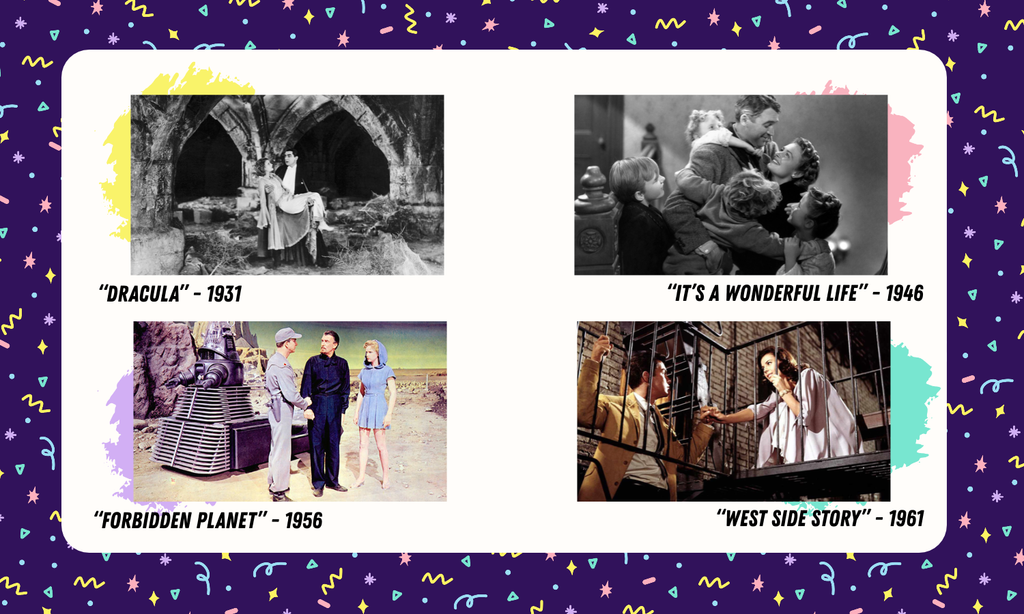
Our timeline for this article starts in 1931, with two iconic Halloween classics that premiered 95 years ago, kickstarting the Universal Monsters series: Dracula and Frankenstein. Both adapted from books, and subsequential stage adaptations, a sure-fire way to get Universal Studios out of a financial slump from the previous year. Ten years later, Orson Welles’ highly regarded Citizen Kane released in theaters to critical and financial acclaim from RKO Pictures, although it was unable to recoup production costs. Speaking of RKO, I have to spotlight a Christmas classic, James Stewart’s It’s a Wonderful Life, which released in theaters in 1946. (You can read more about RKO Picture’s history in our article, here.)
1951 would be a lackluster year for films, but it would be unlike me to include some science-fiction picks from this year; Robert Wise’s The Day the Earth Stood Still and Edgar G. Ulmer’s The Man from Planet X. Five years later, and the science-fiction community is thriving with Invasion of the Body Snatchers and Forbidden Planet, and the Americanized release of Godzilla. Also, of pop culture note is Cecil B. DeMille’s The Ten Commandments, which was a dramatic retelling of books from the Bible and the story of Moses. 1961 was a busy year for theater-goers! The year saw the theatrical release of Robert Stevenson’s The Absent Minded Professor, Blake Edwards’ Breakfast at Tiffany’s, David Swift’s The Parent Trap, and Robert Wise and Jerome Robbins’ West Side Story. A good mix of comedies, dramas, and rhythmic snapping fingers, if you ask me!
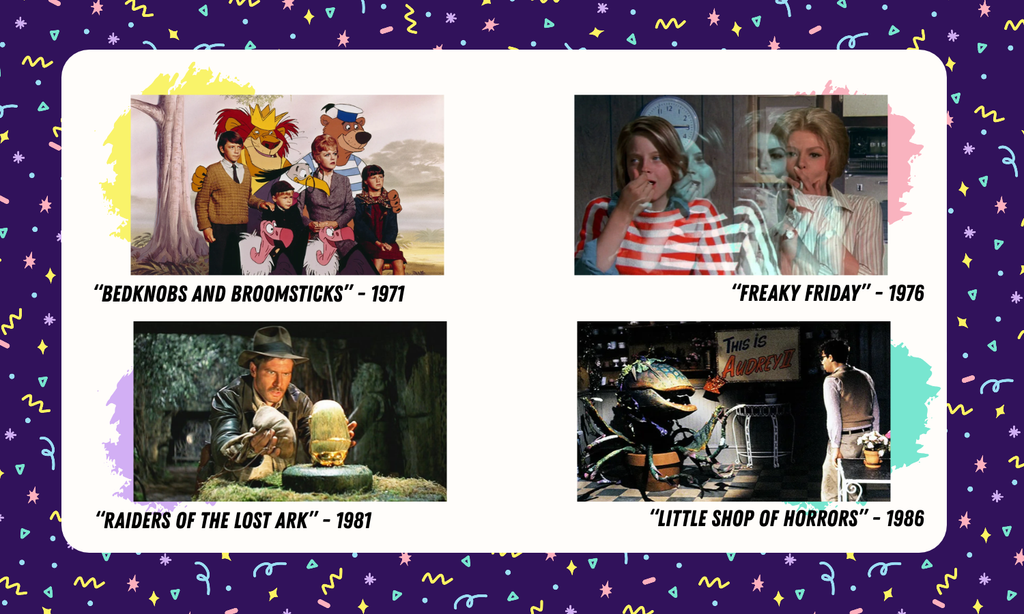
We jump forward a decade for the delightful and delectable Willy Wonka and the Chocolate Factory, featuring Gene Wilder in the titular role, in 1971. Also releasing that year are Harold and Maude, A Clockwork Orange, and Bedknobs and Broomsticks, for a good tonal whiplash. Well, the 1970s are like trail mix: you never know what you’re going to get. In 1976, cinephiles could enjoy serialized murder-mystery genre spoof Murder by Death, bone-chilling horror The Omen and Stephen King adaptation Carrie, underdog-turned-superstar boxer Rocky, and the original body-swapping comedy Freaky Friday.
By the late 1970s, a new technology started to emerge: computers. With computers came new ways to process and record film. No longer was film stock necessary with digital film, and the new technology opened up the floodgates with blue screen special effects, post production editing, higher definition recordings, and, as the 1980s progressed, more and more specific computer programs were developed to process animation; first as simplistic lines that formed logos for commercials, to experimental short films and brief special effects, and even some groundbreaking interlaced computer powered effects found in movies like TRON (1982). As long as your computer had the processing power to analyze and output the given data, and the budget to pay for the inevitably high electric bill, the sky was the limit. Movies became more clear, more crisp, although many filmmakers still preferred to use film stock and were hesitant to use the new technology for the visual effects and post production editing. (For an example of digital film and blue screens being heavily utilized for special effects, check out the Go West’s Call Me [1985] music video. Sorry for the earworm, reader!)
John Hughes, Steven Spielberg, Chris Columbus, and many iconic stars, more than I could possibly list, creating a handful of classics that continue to get airtime in the 1980s. Forty-five years ago, audiences could see the premieres of Raiders of the Lost Ark, which introduced audiences to archeologist Indiana Jones, played by Harrison Ford; The Great Muppet Caper, which tossed the Muppet characters into a parodical jewel heist; comedy Arthur, featuring Dudley Moore in the charismatic titular role; and, for audiences seeking a horror thrill, The Evil Dead‘s first installment rounded out the year. 1986 saw John Hughes’ Ferris Bueller’s Day Off and Pretty in Pink starring Matthew Brodrick and Molly Ringwald, respectively, in the lead roles. Leading up to Halloween, Critters, a notorious rip-off of Joe Dante’s earlier Gremlins, was released to terrorize audiences this year, and spun a franchise featuring the fanged little beasts. I also have to spotlight Frank Oz’s Little Shop of Horrors, a direct adaptation of the dark comedy, off-Broadway musical by Howard Ashman, which premiered, in two different versions in 1986. (The original ending featured a global takeover by gigantic carnivorous plants but it was panned as too gloomy from test audiences. As someone who has seen this cut play out in a theatrical showing- this is the better experience!) 1986 also saw the release of the original Top Gun, starring Tom Cruise; Jim Henson’s Labyrinth, featuring David Bowie and a new, fantastical world of puppets; critically panned but cult classic film adaptation of comic Howard the Duck; and, Stand By Me, based on a Stephen King novella and featuring a star-studded cast of young actors.
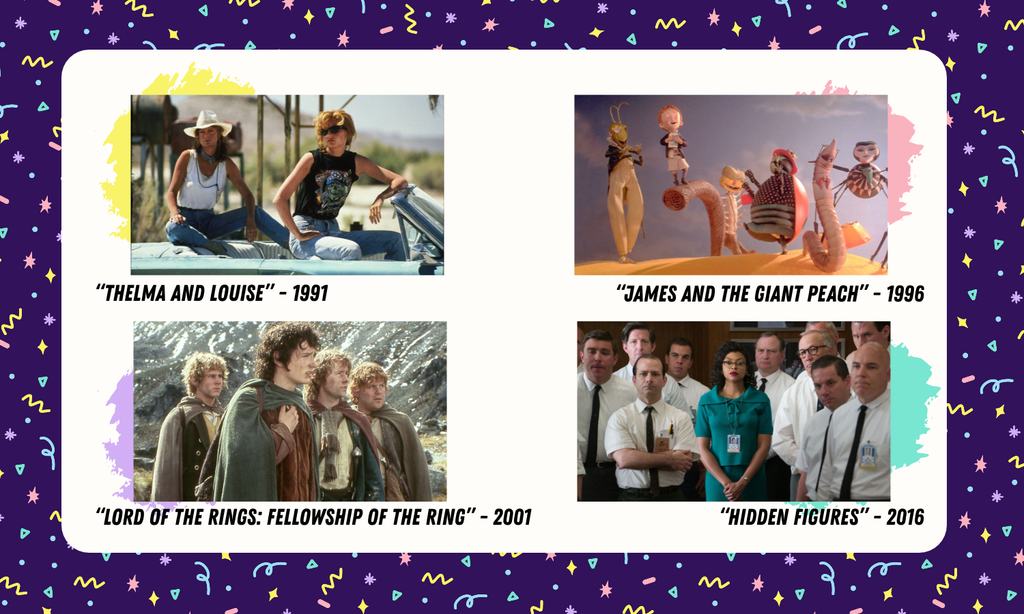
The 1990s also proved favorable for audiences. Thirty-five years ago, movie goers could have seen the film adaptation of family/dark comedy The Addams Family, the skin-crawling performance of Anthony Hopkins in The Silence of the Lambs, Steve Martin in the comedic Father of the Bride, feminist classic Thelma and Louise, and summer comedy What About Bob?. I have to spotlight a personal favorite, Drop Dead Fred, coming from New Line Cinema (read my article about that studio, here), which features some great practical effects. Five years later, and the box office was flooded with action adventures, comedies, and dramas. The Muppets returned to the big screen with Muppet Treasure Island, a loose adaptation of the novel of the same name by Robert Louis Stevenson, and for another family friendly classic, check out James and the Giant Peach, a visually unique adaptation of the novel by Roald Dahl. Adam Sandler’s Happy Gilmore saw the titular, fictious character go from hockey failure to golf superstar and Twister captivated thrill-seeking audiences with storm chasers trying to capture the most extreme tornadoes. Competing for similar audiences was the well-received Mission: Impossible featuring Tom Cruise as experienced spy, and Spy Hard, a direct spoof of the spy genre featuring Leslie Nielson. Scream terrorized audiences and brought a new wave of slasher horror, for the next generation; Space Jam crossed basketball superstar Michael Jordan with classic Looney Tunes characters; and extraterrestrials attempted to invade the globe with Independence Day.
We’ve hit the millennium! 2001 saw the premiere of multiple adaptations that became instant blockbusters- specifically, Harry Potter and the Sorcerer’s Stone, based on the first book in the Harry Potter series by J.K. Rowling, and The Lord of the Rings: The Fellowship of the Ring, adapted from J.R.R. Tolkien’s novel. Romantic comedy Bridget Jones’s Diary and The Princess Diaries, both book-to-movie adaptations, arrived on the big screen, as did cult classics Ghost World and Monkeybone, both based on indie comic books. Original comedies Zoolander and Legally Blonde also debuted this year. Jump forward to 2006, and the theatrical market has become saturated with family-friendly movies. Night at the Museum brought statues, fossils, and figurines to life in a fantastical version of the American Museum of Natural History in NYC; a live action adaptation of EB White’s Charlotte’s Web and Thomas Rockwell’s How to Eat Fried Worms. To break the trend is the adaptation of highly praised mature comic V for Vendetta; mystery thriller The Da Vinci Code, which used real-life paintings and artifacts as an interactive treasure map to find the famed Holy Grail; and Idiocracy, which imagined a future where everything is to the idiotic extreme. Audiences in 2011 were treated to a mix of sequels and remakes. Of the original offerings for this year, check out Super 8, directed by J.J. Abrams (and set in Ohio!); Hugo, based on Brian Selznick’s The Invention of Hugo Cabret, which twists early film history and the works of Georges Méliès with a fictious mystery involving an automaton; and Soul Surfer, which told the story of surfer and shark attack survivor Bethany Hamilton. 2016 saw the theatrical releases of book-to-film adaptations The 5th Wave, The BFG and Miss Peregrine’s Home for Peculiar Children; dark comedy Swiss Army Man; star-studded musical La La Land; and biographical drama Hidden Figures.
As we get closer to the present, it should be noted how much the COVID pandemic impacted the film industry, and the consequent writers and actors strikes with the rise of Artificial Intelligence programs threatening the creative future of innumerous positions and roles, in turn, impacted the quality and quantity of films to be released. Streaming services may have started in the early 2000s, but when everyone was in lockdown, having new media to entertain the masses was essential to attract viewers, and their wallets, to their platforms. It became commonplace to see movies pulled quickly from theaters, dropped to a sole streaming platform, all in the course of a month’s time. The uptick in sequels and remakes in the 2010s only continued, with fewer and fewer original entries entering the zeitgeist. Gone were the days of the original summer blockbusters, and with the rising costs of tickets and concessions, are audiences still going out to see the movies? Or are the days of the theatrical release something fading behind us, as a society, a relic of a by-gone era? We haven’t gone quite to the point of no return, but considering the current trends, I believe it’ll take truly dedicated fans of movies to keep the experience of original theatrical releases alive. So, here’s a new challenge for you, my dear reader- if you are able, see a movie in the theaters, purchase some salty and sweet snack from the concessions stand, and enjoy the show!
Did you know that your Westlake Porter Public Library card can be used to borrow media on streaming platforms hoopla Digital, Kanopy, and OverDrive/Libby for free? Learn about how to access hundreds of titles and more by visiting this page.
I hope you enjoyed this article, and I’ll see you in December for one last installment for 2026!