If you’re a longtime reader of the series, you know just how much I adore animation- the history of it, the studios that created my favorite cartoons and movies, even the entire progress of it, learning how to animate traditionally on paper and on the computer. For those who aren’t familiar with me (or as a refresher), I have a Bachelor of Fine Arts degree in Animation, and took two animation and film history courses while studying for my undergrad. The history of animation, from it’s roots in vaudeville acts in the early 1900s through to modern day, is a fascinating story and one overflowing with colorful characters, drama and scandal. Each studio took the medium and added new methods to the craft, from traditional cel animation to computer animation software that can process and animate hundreds of strands of hair on a woolly mammoth in real time. This medium transcends just a singular genre, proving time and time again that animation is not just for kids, and can appeal to a much, much wider audience… if given the chance. No studio would prove this sentiment more than Blue Sky Studios – the studio that produced some of the best animated films of the 2000s before being crushed by Disney in 2021. Let’s push back the clock to the dawn of Computer Generated Animation, and a little startup studio that quickly changed the way we view animation…
The Birth of Computer Generated Images
Nowadays, computers are more commonplace than ever before. You might even be reading this off of one, that little rectangular device that fits comfortably in your back pocket! But back in the late 1970s, computers took whole rooms to calculate solutions to seemingly unsolvable problems and helped astronauts land on the moon, and software engineering was a brand new concept! Who would develop it? What power could computers hold? Restricted only by a string of code, composed of zeroes and ones, the opportunities were endless… but the technology needed to catch up. After all, computers were still relatively new, the science was still in its infancy, and companies needed millions of dollars to invest into this new technology – and would only invest if they saw potential in somehow making back the costs. One of the earliest usages of these computers was a primitive animation software. Early computer animators punched in coordinates into the software to create objects or movement, hoping that their math was on-point and correct, and wait over night to see their five second animation after it finished processing. This was all before computers had screens, so animators were going in blind, hoping that they didn’t accidentally mistype a number, or the whole day’s work would be wasted. But when the early Computer Generated Images created animation- no matter how rough- it was highly praised and sought after, and began to be used in short bursts, like commercials and special effects. The world’s view on CGI would be shifted in 1982 with Disney’s Tron– which fully integrated the new software with life action sequences and actors, perfect for a Sci-Fi film set in cyberspace.
(Compared to the CGI animation incorporated into blockbuster life action films today, Tron has not aged well. But back in 1982, this was revolutionary stuff!)
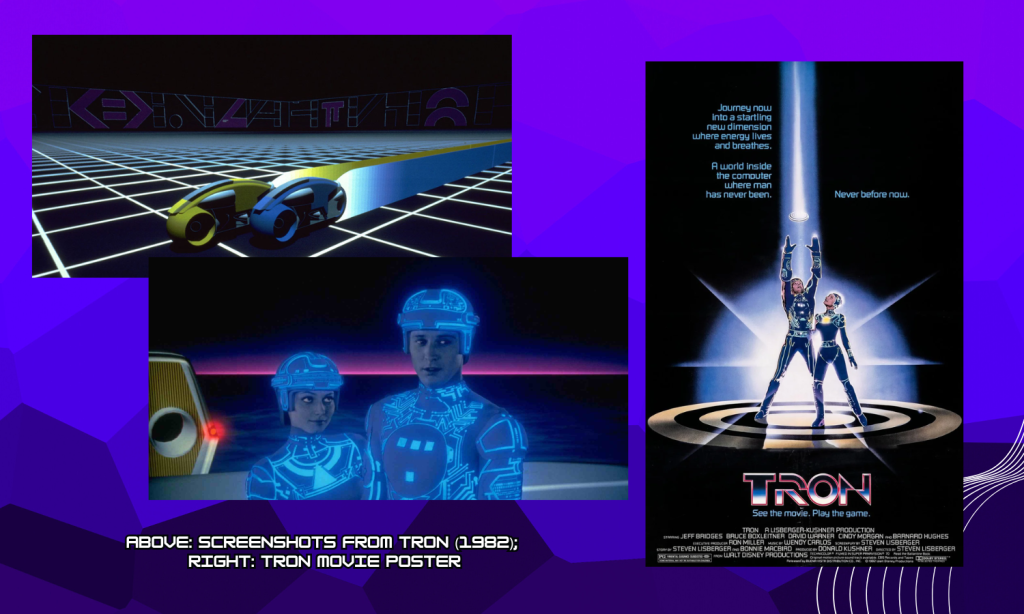
Who were the animators behind Tron‘s revolutionary special effects? Mathematical Applications Group, Inc. (MAGI), one of the early CGI-focused computer technology companies. As lead animator on the Tron, Chris Wedge started to build a bit of a team of animators, physicists, engineers, executives and producers at MAGI, but by the mid-1980s, the company’s management team was going through some drastic turnovers and eventually went out of business. Frustrated, and freshly out of work, Chris Wedge and the team he had built at MAGI (Eugene Troubetzkoy, Mike Ferraro, Carl Ludwig, David Brown, and Alison Brown) founded Blue Sky Studios in 1987. With the nearly formed team, the focus shifted from technical contract work with the US Government to producing CGI animation for special effects. One of the hardest things to render – at the time- was lighting. The animation (as simple as it was back then) would need to be processed, and then an animator or digital artist would add appropriate lighting and shading frame-by-frame- a tedious and time consuming task. Using the software from MAGI, Troubetzkoy and Ludwig adapted algorithms to simulate the physical properties of light in order to produce lighting effects automatically for the animation. Two years later, and with some more experimentation, Blue Sky Studios would get their first of many commercial deals- but depended on a local graphic studio for extra processors to complete the job.
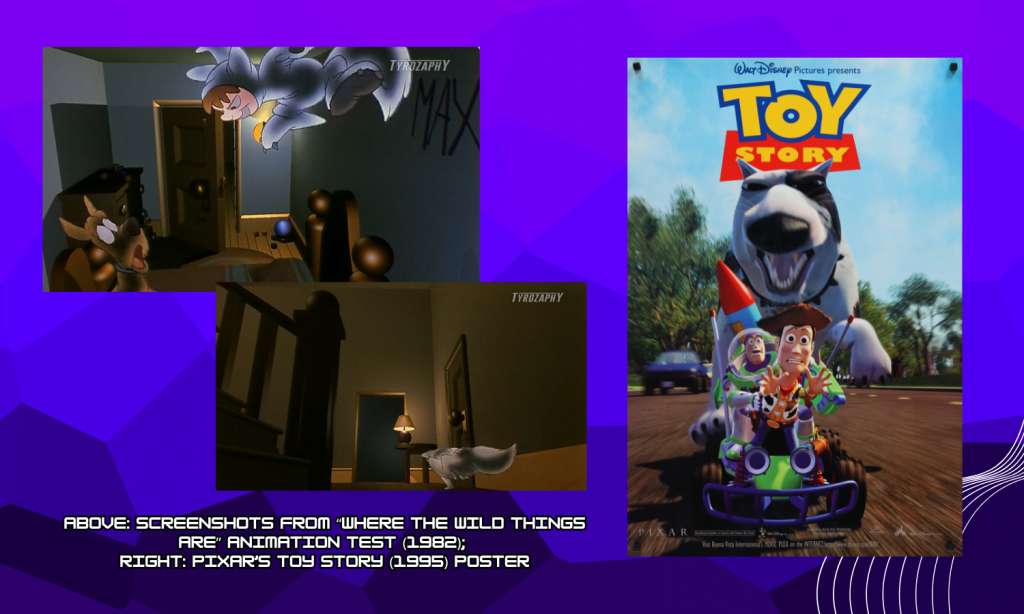
Blue Sky Studios hit the ground running in 1987, and quickly became a household name- for making unique and eye catching commercials for their numerous clients. From pharmaceuticals (animation was used to show how dissolvable pills dissolved), to snappy M&M’s (based on the original animated designs- Will Vinton Studios designed the CGI M&M’s mascots that are used in merchandise and advertising to this day), Blue Sky was almost as prolific in the CGI biz as Pixar, which had been slowing down in their commercial work by the mid-1990s. Speaking of Pixar, in 1983, Disney commissioned MAGI for an animation test featuring Max from Where the Wild Things Are, to test how CGI animation could be integrated with traditional animation. Animated tests were completed, with Glen Keane and John Lasseter tasked with drawing over the CGI furniture and rooms, and a traditionally animated Max and his dog. Although the short is a great example of how this early technology could be incorporated and could help with the animation process, Disney did not like working with MAGI and it wasn’t a cheap experiment. Frustrated by Disney’s lack of interest, Lasseter would quit and join George Lucas and Steve Jobs, forming Pixar in 1986. CGI commercials were the newest, hippest thing, quickly replacing Will Vinton’s claymation – but that would change with Pixar’s first full length animated film “Toy Story” (1995). With Pixar now focused on their films, Blue Sky Studios had their pick of the commercial market and started to be involved in more special effects in live action movies, slowly working up to their first movie.
Bunny, Mammoths, and a Pandemic
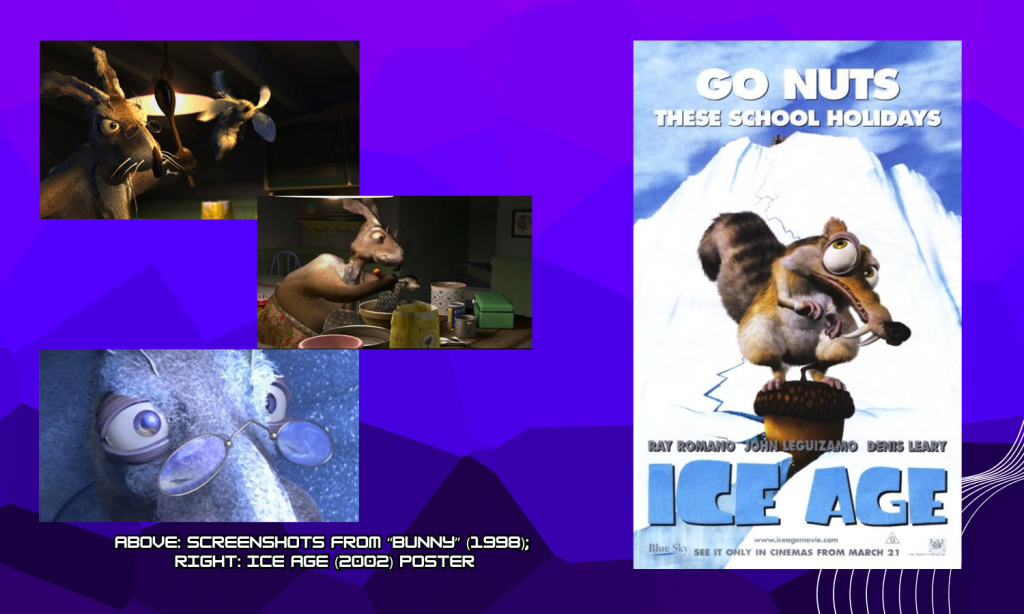
In 1990, Chris Wedge came up with the idea for a CGI animated short- and it would be like nothing Blue Sky Studios had produced before. The concept? An elderly bunny widow is haunted by a moth, which eventually leads her to the afterlife, reuniting her with her deceased husband. Pretty grim, and compared to what Pixar was producing at the time, very mature. The storyboards were fantastic and the concept art was produced, but the technology fell short, yet again, limiting the potential for the short. Bunny went on the backburner, shelved until the technology could catch up to the visuals. Nearly eight years later, Wedge was able to return to Bunny, and the short film released with wildly positive accolades, even winning the Academy Award for Best Animated Short Film in 1998. Finally Blue Sky Studios had proved that they could tell stories with their animation softwares, and compete against the rising Pixar and Dreamworks. Although Pixar had beat the trio of CGI animation studios at the time, releasing the first entirely CGI animated full feature film in 1995, Blue Sky Studios and Dreamworks were perfecting their softwares and techniques, taking tougher projects that forced them to animate the toughest subjects for CGI at the time- water, fur, light, and stylized humans.
In order to produce a full feature film, Blue Sky needed financial backers and producers to invest in the project. They had made a deal in the mid-90s with Fox, which had created and funded a visual effects department within Blue Sky, but by early 2000, Fox was considering selling their share in the company. Wedge and his team had been working on a space science fiction opera film akin to Star Wars, but the concept was just too complex for the team to tackle with the technology they had. Concurrently, Don Bluth Studios, working under Fox Animation Studios, was trying to stamp out a story set in last global ice age, with a ragtag team of animals trying to survive the barren wasteland and re-unite a human baby with its migratory family. With Fox taking the reins with both animation studios, it was evident that the concepts needed to be traded off or scrapped all together. Don Bluth and his animation studio would be given what would become 2000’s Titan A.E., the last full feature animated film ever produced by Don Bluth Studios and a financial flop, while Blue Sky Studios created 2002’s Ice Age, a critical and financial success. Fox closed down Fox Animation Studios soon after Titan A.E.‘s release, refocusing their budgets and talents to Blue Sky Studios.
In the 2000s, Blue Sky Studios would continue to produce more full feature films, continuing to make lasting and entertaining family films and connecting to audiences across the globe. Robots (2005) would create an unique world full of anthropomorphic robots trying to get replacement body parts and unable to access them due to poverty, and Rio (2011) and Rio 2 (2014) would shed light on the exotic animal trade and safely rehabilitating endangered species. Blue Sky would also adapt some stories into the CGI format- Epic (2013), loosely based on William Joyce’s The Leaf Men and the Brave Good Bugs; The Peanuts Movie (2015), based on Charles Schultz’s iconic Peanuts comic strips and characters; and Ferdinand (2017), loosely based on The Story of Ferdinand by Munro Leaf and Robert Lawson, just to name a few. Meanwhile, the world of Ice Age continued to expand, eventually gaining four sequels, many specials, video games, and an original episodic series based around Scrat, the comedy relief saber-toothed squirrel, his son, and their never-ending hunt for the acorn.
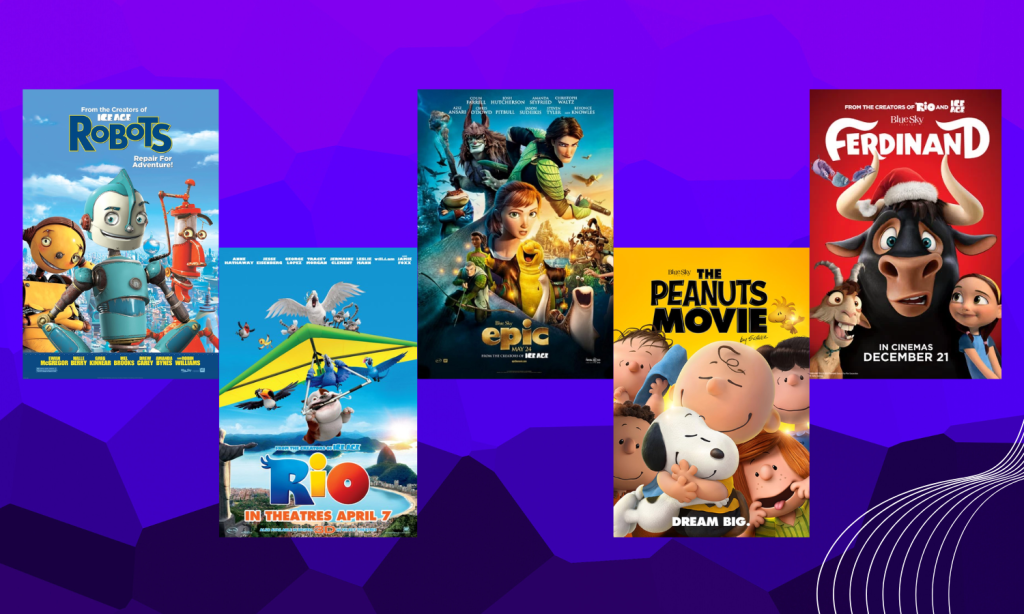
The last full feature film released by Blue Sky Studios would be 2019’s Spies in Disguise, although the studio had been deep in production on the film adaptation of ND Stevenson’s Nimona before Disney bought Fox in 2020. With this acquisition, Blue Sky Studio was dissolved in 2021, staff laid off, and any additional projects were either scrapped, given to Disney or sold to other animation studios. Nimona would be finished by DNEG Animation and premiered on Netflix in 2023, downgraded from a theatrical release. Now that Disney owns Blue Sky Studio’s filmography – and by default, their wide range of popular characters- we may see them again in movies and direct-to-streaming animated shows in the future.
Last Thoughts
When I was enrolled at the Savannah College of Art and Design (SCAD) for my undergrad, I was able to take two courses taught by Professor Jan Carlee. Although very little has been written about Prof. Carlee online, his career had spanned three decades in the animation industry, specializing in CGI integration in traditionally animated films and commercials, from helping with CGI effects on Tron to working alongside Don Bluth on Titan A.E., eventually switching to help Blue Sky Studios on production on Ice Age, and as an animation director for a series of animated segments for Sesame Street in the mid 2000s. Needless to say, Carlee had years of experience to share with his students and he was a master in storytelling, both personal anecdotes and re-telling industry stories and conflicts, mistakes and burnt bridges, and behind the scenes secrets. I was very fortunate to have visited SCAD’s Don Bluth Studio Collection in the Jen Library twice during my studies, donated by Don Bluth and Gary Goldman in the early 2000s, a mixture of various production pieces from the studio’s filmography and concept artwork- including many pieces from Titan A.E. Regardless of how the film turned out, you can’t deny just how much talent was poured into the production- each piece is overflowing with care, love and character. As I researched for this article, I became curious how Don Bluth’s version of Ice Age might have turned out if it wasn’t switched for Titan A.E.; unfortunately, all of the concept artwork produced before the trade has been locked away in Disney’s vault and became lost media.
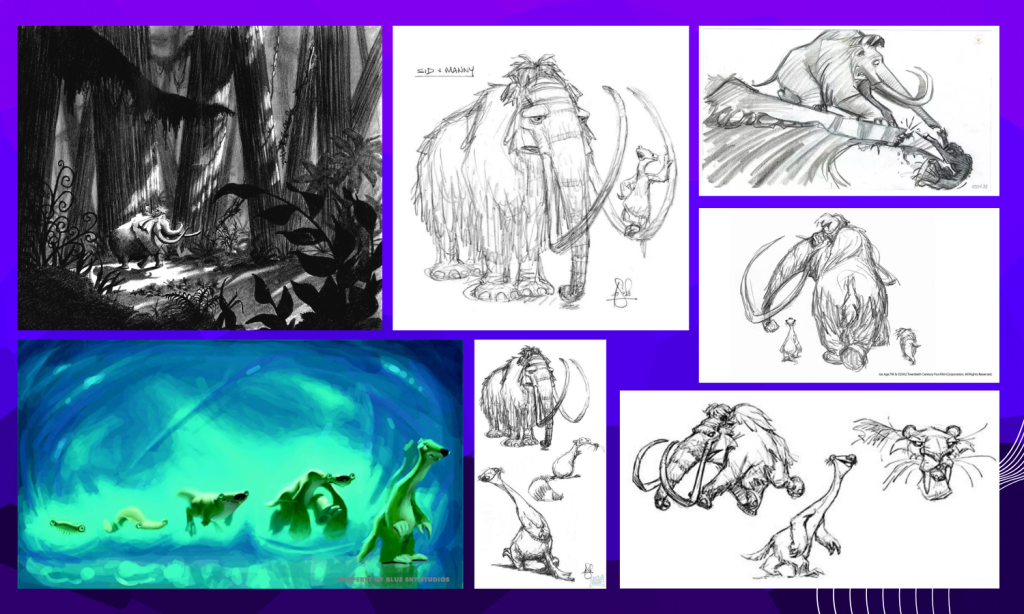
(Enjoy this little collage of concept art above produced for Ice Age (2002), produced by the artists and designers of Blue Sky Studios from 1998-2001.)
Growing up as a child of the early 2000s, I loved Blue Sky Studios films. One of my journals from elementary school even mentions the studio by name, in a wishful desire to work there one day as an animator. That wish ended in 2021- the same year I graduated college and just a month short of my graduation, when Disney shut Blue Sky Studios down. The pandemic and the consequential strikes destroyed the animation industry, although animated shows and movies entertained millions of viewers through one of the roughest and unknown years of recent history. While this series has focused primarily on the past and the studios that made the franchises we’re nostalgic about, we should also adapt to whatever the future brings us going forward and always support animated works created by humans. Watch the films created by Blue Sky Studios and revisit your favorite characters and stories from their many franchises. More importantly, and more than ever before, support new studios and the animated shows and films and shows they produce directly – you might just help prevent another studio from becoming defunct. And remember- keep reaching for that acorn, that wish, that dream… someday, you just might get it.
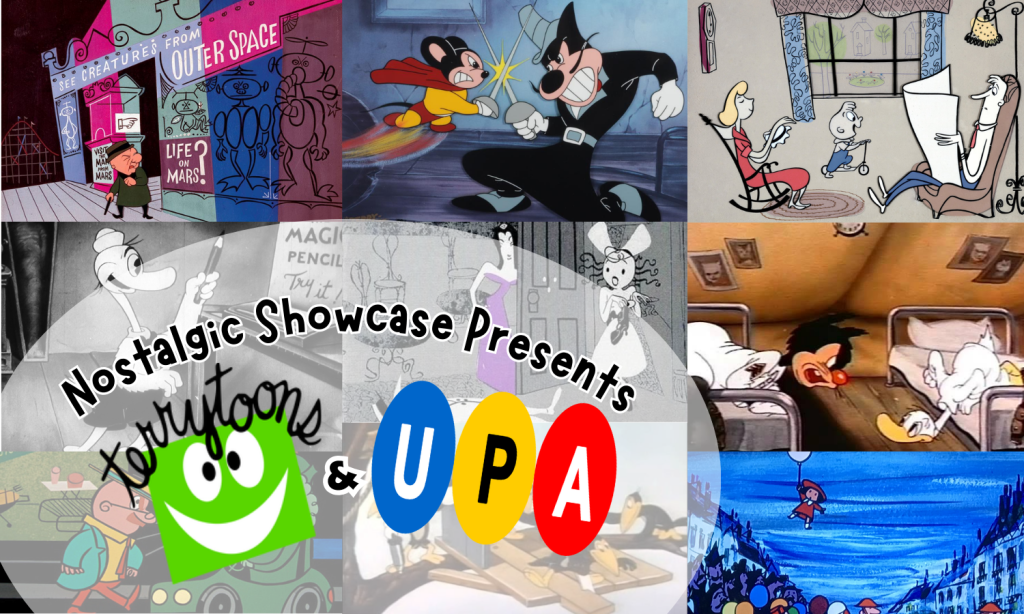
Stay tuned for next month’s article on two of the most iconic and stylistically impactful animation studios- Terrytoons and UPA!
Sources
An Oral History of Scrat Tales: The Death and Legacy of Blue Sky Studios
What Blue Sky Studios Was and Why it Shut Down
Off into the Wild Blue Sky: Reflecting on the ‘Ice Age’ Studio’s Legacy