One of my fondest memories growing up involves my two older cousins and I, sitting around my parent’s box television, trying to cool down from the humid Michigan summer heat. We devoured otter pops and fresh watermelon slices, wearing the lightest clothes in our closets, rotating fan on full blast, all the windows in the house open. Always the leader, my oldest cousin took control of the remote and surfed the channels, trying to find something silly and fun and animated for the three of us to enjoy. To us, summer vacation would not be complete without those Saturday Morning Cartoons, a block of new and rerun cartoons made for kids! No cartoon studio would be more infamous for producing as many 60’s-80’s classics as the subject of this article, creating numerous cult classics and unforgettable memes, loveable characters and catchy songs. Next up in our line-up of Summer Saturday Morning Cartoons is one of the more iconic animation/production studios of yesteryear- FILMATION!

Three Business Men and Rod Rocket
The story of FILMATION starts, like most defunct Hollywood studios, with a couple of animators trying to find their footing in the industry. It’s the early 1960s, and animation produced by big-name studios is styled for simplicity, low budgets, and quantity over quality. This was the early days of animated content made exclusively for television, and stations like ABC and CBS needed short content shows to entertain both kids and families alike, and fast. Enter Lou Scheimer and Hal Sutherland, two animators that have been trying to dig their heels in the shifting sands of the animation industry. The pair met in 1957 while working at the defunct Larry Harmon Pictures studio, on the short-lived made-for-TV animated adaptions of Bozo the Clown and Popeye. After Larry Harmon Pictures studio closed in 1961, Scheimer and Sutherland continued to gain more experience on low budget productions, while working at True Line. Scheimer and Sutherland would get the attention of SIB Productions, a Japan-based company, who contracted the animators to make sixty-five, five minute long episodes of Rod Rocket, a simplistic atomic-era cartoon about two friends exploring space and fighting cosmonauts. Around this time, Scheimer and Sutherland would also sign on for a contract with Family Films, producing a short series of religious animated shorts called The Life of Christ. Most of the Rod Rocket and The Life of Christ shorts have become lost media.
In the middle of Rod Rocket and The Life of Christ‘s productions, Scheimer and Sutherland met Norm Prescott, who had a knack for radio and entertainment. The trio would become quick friends, and strong professional partners. By 1962, they left True Line to form their own production company- the aptly named “FILMATION Associates”. Rod Rocket would be syndicated on national television in 1963, the first FILMATION cartoon to hit the airwaves.

Norm Prescott got the ball rolling on their first endeavor into long-form media, an animated pseudo-sequel to MGM’s The Wizard of Oz, Journey Back to Oz. Quickly overwhelmed with production costs and falling sharply into debt, the trio decided to take a step back from Journey Back to Oz, focusing instead on producing commercials and signing contracts for smaller projects. This hiatus would last eight years, finally releasing in 1972, with Liza Minnelli, Mickey Rooney, and Margaret Hamilton starring as voice actors. Notably, Liza Minnelli would step into the role of Dorothy, which had been performed previously by Judy Garland, Minnelli’s mother, about thirty-three years prior. Journey Back to Oz would find success, like many of FILMATION’s works, in syndicated television.
Superheroes Saved FILMATION, and The Archies‘ Hit Single
Finding themselves strapped for money, after being forced to shelf Journey Back to Oz in 1962, the trio scrambled for more contract work and expanding their portfolio. Their next big idea, a kid’s show called The Adventures of Stanley Stoutheart, about a kid and his pet dog, their first original concept. The trio spent a period of time trying desperately to sell it to any big name studio for finances, to be denied again and again. FILMATION was just about to close down, defeated and penniless. But this isn’t the end of FILMATION’s story… it’s just the beginning.
The trio’s work on the commercials and Rod Rocket caught the attention of DC Comics editor Mort Weisinger, who contacted FILMATION to make a Superman cartoon. This would start the long-term business partnership between FILMATION and DC Comics, with FILMATION producing a total of eleven long-running syndicated cartoons based on DC Comic’s main catalogue of superheroes from 1966 through 1982. FILMATION’s take on the extended DC Comics universe would bring many new and returning characters to the silver screen, featuring the cast of the Justice League (with spin-offs focusing on the action-packed adventures of Batman, Superman, and Aquaman) and various villains. FILMATION’s The Adventures of Superman, unlike Fleischer Studios’ take on the man of steel, was more true in design to the comic book style and borrowed many of the artists and writers employed by DC Comics to help write and design for the animated adaption. Voice actors, who had either been hired to voice characters on the Fleischer Studios version or on radio serials, were brought back to the franchise to reprise their roles.
This partnership would also create the perfect space for FILMATION to perfect- or rather, cut back- on their animation. Prior to the partnership with DC Comics, FILMATION’s animation leaned heavily into the UPA (United Productions of America) style, popularized by Gerald McBoing-Boing (1950), Mister Magoo (1960-1962), and many of the funny animal cartoons produced by Hanna-Barbera. The UPA style is categorized by three things, all for efficiency and simplicity; lines, colors, and depth. UPA animators could thoughtfully use as few lines as possible, with the barest color palettes, and the flattest backgrounds, and still tell a captivating and entertaining story. FILMATION’s commercial work prior to being contracted by DC Comics was still being animated in the UPA style. This, of course, changed with The Adventures of Superman, which forced the trio to learn to animate more closely to the drawn style of the comics, refocusing on action sequences, less drawings, and re-using animation as frequently as possible. This would become a trademark for all of FILMATION’s works going forward, producing a more choppy, but more unique, style that makes any FILMATION cartoon recognizable to this day.

Unlike other Saturday morning cartoon studios, FILMATION did not want to purchase the rights to the characters or real life celebrities likenesses, a practice that often turned away potential partnerships. Instead, the trio would take offers to temporarily contract out the rights to animate the characters or real life celebrities, and produced a show closely with the contractor, creating a respectful partnership. Another positive? FILMATION was one of few Saturday Morning Cartoon producing studios to keep their animation productions within the United States of America, producing cartoons in-house, for the entirety of its run- something that many modern American studios can’t claim. Their partners never had to fret about international taxes or language miscommunications or guilds or unions; everything was kept in the USA. It was a breath of fresh air, return to the way the industry used to be, and firms were taking note of FILMATION.
FILMATION was on a roll when the trio (and now, expanded team of animators, layout artists, writers, and other creatives) was approached by Archie Comics, to adapt their star cast of characters into an animated space. The Archies was the beginning of another long-running partnership between FILMATION and a comic book publisher, moving past superheroes and going straight for slice-of-life comedies made for a teenage audience. The Archies was focused on Archie Andrews, Jughead Jones, Veronica and Betty, Reggie, and Hot Dog, the group’s adorable dog sidekick, as they deal with typical high school mischief and playing in a band, sharing its’ name with the show. In 1969, The Archies would make television history as the first fictional animated band to produce a Billboard’s Hot 100 hit, with Sugar, Sugar, which is regarded as one of the best bubblegum pop songs from that era. FILMATION would go on to make eight more animated series with Archie Comics, airing up into 1977.

Other partnerships focused their adaptions to younger demographics, with FILMATION producing their own takes on Terrytoon’s Heckle and Jeckle and Mighty Mouse (The New Adventures of Mighty Mouse and Heckle & Jeckle, 1979-1980), MGM’s Tom and Jerry (The Tom and Jerry Comedy Show, 1980), TMS Entertainment’s Zorro (The New Adventures of Zorro, 1981-1982). Bill Cosby would also hire FILMATION to make a couple of animated series, the most well-known of which is Fat Albert and the Cosby Kids (1972-1976), with the titular main character voiced by Bill Cosby. This series would be adapted into a critically panned (and forgettable) live action/animated movie in 2004, Fat Albert, in which the animated characters from the FILMATION series are forced into the real world.
The Ghost Busters and a Lawsuit
If you’ve an avid reader of this series, you know I already name-dropped FILMATION and their original The Ghost Busters live action series in my article on DIC Entertainment. But for those not in the know, FILMATION had produced a very campy live action series called The Ghost Busters in 1975, pre-dating Columbia Pictures’ live action film Ghostbusters by a solid decade. FILMATION’s series revolved around a slapstick trio of characters, two humans and one gorilla, as they solve supernatural mysteries and bag monsters. Sound familiar? It’s no surprise that FILMATION would be jumping on the bandwagon of Scooby-Doo copies and dupes, and The Ghost Busters was one of the worst, only airing fifteen episodes. Yet, because FILMATION owned the rights to The Ghost Busters name, Columbia Pictures had to face FILMATION in copyright court, eventually paying FILMATION a fee to use the name for the film.

When the Columbia Pictures Ghostbusters proved to be a overwhelming box-office success, smack-dab in the middle of the Saturday Morning Cartoon wave of the 1980s, a cartoon adaption of the movie was naturally the next step. Even after the legal debacle regarding the Ghost Busters name rights, FILMATION offered to make the cartoon adaption for Columbia Pictures. Surprising no one, Columbia Pictures picked a different animation studio, DIC Entertainment, to make the cartoon. FILMATION quickly produced a cartoon based on their The Ghost Busters live action series, with the next generation of quirky ghost busting professionals and their gorilla side-kick taking center stage. The first episode of FILMATION’s animated series Ghostbusters aired on September 8th, 1986… to a confused audience. DIC’s The Real Ghostbusters – named to avoid further copyright issues with FILMATION – would air its first episode a mere week later, on September 13th. FILMATION’s cartoon adaption, falling in the footsteps of its live action origin, lasting for one, unremarkable season before being cancelled. The Real Ghostbusters, on the other hand, was renewed for six more seasons and a spin-off season focusing on the mascot of the show, a big green gobbling ghost named Slimer. It had become blatantly clear to both studios- FILMATION and Columbia Pictures- which of the two ghost-busting franchises wouldn’t be left in the dust, and it wasn’t the one with the gorilla.
He-Man and What Became of FILMATION
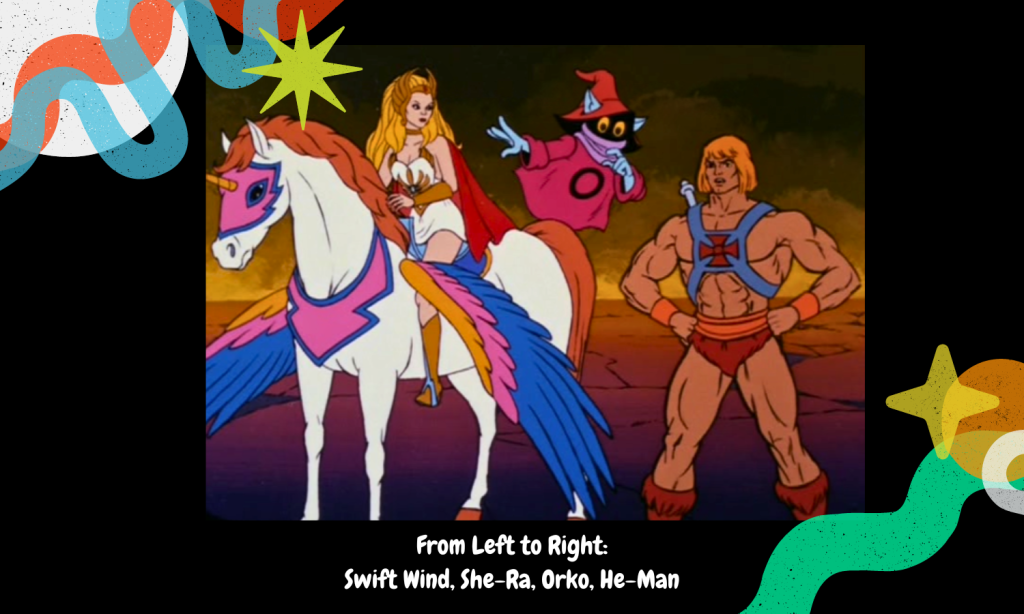
Any article about FILMATION would not be complete without mentioning He-Man and the Masters of the Universe (1983-1985)! This fantasy series, commissioned as a show to promote a toy line created by Mattel, was an instant hit and one of FILMATION’s most memorable franchises. This was due, in part, to Mattel’s side of the deal, creating merchandise tie-ins for the animated show, providing the studio funding for a Christmas special in 1985 and a theatrical movie that same year. Less than a year after He-Man was finished airing new episodes, She-Ra: Princesses of Power, a quasi-spin-off/continuum of the original show hit the airwaves. She-Ra featured many of the same components of the He-Man series, focusing on a many female cast of characters instead, attempting to appeal to a female demographic. She-Ra would also be incorporated into the 1985 Christmas special. The 1980s was full of kids shows loosely adapting kid’s toys into shows and movies, and He-Man and She-Ra, for better or for worse, became one of the more memorable of these, evolving into it’s own wider franchise. Since FILMATION’s original iteration of these characters, the fantastical world of Eternia has been adapted into various cartoon series, comic book series, and live action and animated movies, as recent as 2018 with Netflix’s She-Ra and the Princesses of Power. Depending on what generation you belong to, you might strongly associate FILMATION solely with He-Man and She-Ra, the iconic Castle Grayskull and main antagonist, Skeletor.
Mattel also commissioned FILMATION for another series, based on a concept drawing created by one of FILMATION’s staff artists, of the main antagonist in a space western series. This would be developed into BraveStarr (1987-1988), which, similarly to He-Man and the Masters of the Universe, received it’s own line of merchandising. However, due to production delays with the series, the merchandise hit the shelves a year before the show was finished, causing viewers to believe the show was based on the toys, and not the other way around. BraveStarr did not gain the same amount of fanfare as He-Man, and was cancelled after one season.
Around the same time that FILMATION was starting production on He-Man, the studio decided to produce a movie based on the fairytale of Snow White, titled Happily Ever After. While the in-house animation team was working hard on their contract work for Mattel, 60% of the animation for Happily Ever After was done overseas. Similarly to FILMATION’s first attempt at a theatrical animated film, Happily Ever After went over budget and had to be re-written to avoid any potential legal issues with Walt Disney Studios. This animated adaptation was released in theaters three years after FILMATION’s studio was shut down in 1989, a financial flop, making up costs with home releases on VHS, LaserDisc and DVD in the 90s and early 2000s. If Disney’s Snow White and the Seven Dwarves propelled Disney into the theatrical film industry, FILMATION’s Happily Ever After shut FILMATION down.

Ah, the part you’ve been waiting for- what happened to FILMATION to make it fail? The studio was a powerhouse of the 1970s and 1980s, producing memorable adaptions of comic book classics and creating innumerable memories for the kids watching them. Saturday Morning Cartoons was synonymous with FILMATION’s works, even the forgettable ones, and the two were inseparable… right? For thirty years, kids recognized FILMATION’s iconic neon rainbow logo, marking the beginning of a fun and entertaining cartoon, until the studio shuttered its doors at the end of Bravestarr‘s production in 1989.
The downfall of FILMATION started behind the curtain, like most of these studios do, with bad business decisions. Thankfully, unlike DIC Entertainment, FILMATION’s troubles and woes were contained in the USA, but the trio that founded FILMATION weren’t prepared to run their own studio. This was something that had been blatantly obvious with Norm Prescott’s Journey Back to Oz, FILMATION’s first attempt at an animated film, which had nearly shut the studio down in 1962. Seven years later, in 1969, FILMATION would be bought up by now-defunct TelePrompTer Corporation. After merging with H & B American Corporation in 1970, TelePrompTer Corporation became the largest cable television provider in the USA three years later. Sometime later, TelePrompTer Corporation would merge with Westinghouse Electric Corporation. By this time, only Lou Scheimer worked in the studio, as an executive producer.
Right after Bravestarr‘s production ended, Westinghouse sold the rights to FILMATION and its library to Paravision International, which was owned by… L’Oréal. Yes, that L’Oréal, the French cosmetics company, was in line to buy an American animation studio. But right before the sale was completed, Westinghouse shut down FILMATION’s studio. L’Oréal was stuck with FILMATION’s catalogue of productions, which had shared ownership with various other companies. Majority of FILMATION’s in-house produced catalogue would be sold to Hallmark Entertainment; in 2004, Hallmark Entertainment sold this catalogue to Entertainment Rights. While going through the reels of film, Entertainment Rights made a startling discovery- all of the original negative copies, print rolls, original sound masters and archival materials of FILMATION’s catalogue was gone, and only PAL-formatted copies remained, which Hallmark Entertainment had created to distribute the in-house shows internationally. Which meant, unfortunately, that any FILMATION cartoons that were created in-house, and hadn’t been released widely on physical media in the USA prior to Hallmark’s involvement, would have to be copied from the PAL-formatted copies, which sped up the audio by 4% and created a “ghosting” effect with the animation. Any modern releases of FILMATION’s in-house productions would have to be copied from the PAL-formatted copies, which caused a ton of disappointment from fans and Entertainment Rights alike.
Two years later, Entertainment Rights would purchase Classic Media, which expanded their animated catalogue further, including the pre-1974 Rankin/Bass library (check out NSP’s article on Rankin/Bass!), Jay Ward Productions, and Harvey Films/Famous Studios. Entertainment Rights, after a massive layoff in 2009, was then sold to Boomerang Productions (not related to my favorite retro-cartoon channel growing up). Boomerang Productions was then rebranded to Classic Media, which was sold to DreamWorks Animation in 2012, which now owns all of FILMATION’s in-studio productions, to this day.

Final Thoughts
The impact FILMATION had on the Saturday Morning Cartoon line-up is an impressive feat, tackling both campy live-action and limited animation shows in it’s three-decade long tenure into the world of kid’s entertainment. I’m going to be brutally honest here- similarly to my DIC Entertainment post, I had relatively no idea how this studio developed behind the scenes. My introduction to FILMATION’s works was limited, nearly as limited as their signature animation style, having watched ND Stevenson’s She-Ra and the Princesses of Power as it dropped on Netflix, and later, watching FILMATION’s original takes on the He-Man/She-Ra universe. As I researched more into FILMATION’s history, and their extensive filmography, I found myself being surprising just how many shows I remember watching in reruns in my childhood, forgotten by the passage of time. There’s no doubt in my mind that the world of kid’s entertainment was forever changed by The Archie Show‘s catchy hit single Sugar-Sugar and the cultural zeitgeist of He-Man and the Masters of the Universe and the merchandising that followed. I hope this article inspires you to revisit FILMATION’s best cartoons and live action shows from their catalogue!
Join us later this month for the next segment of Summer Saturday Morning Cartoon Studios: Tex Avery’s SCREWBALL CARTOONS!
Watch FILMATION at WPPL!
DC Comics Super Heroes. Vol. 1: The FILMATION Adventures
It’s Saturday Morning! Celebrating the Golden Age of Cartoons
SearchOhio
DC Comics Super Heroes Vol. 2: The FILMATION Adventures
The New Adventures of Superman
Sabrina the Teenage Witch Complete Series
Fat Albert and the Cosby Kids Part 1, Part 2, Part 3
The New Adventures of Gilligan Complete Series
The Brady Kids Complete Series
He-Man and the Masters of the Universe Complete Series
He-Man and She-Ra: A Christmas Special
He-Man and She-Ra: The Secret of the Sword
She-Ra and the Princesses of Power Complete Series
Lou Scheimer: Creating the Filmation Generation
Sources
https://discover.hubpages.com/entertainment/Finding-Filmation-Humble-Beginnings-and-Rod-Rocket
https://www.cartoonbrew.com/video-essay/superman-filmation-lou-scheimer-cbs-video-219980.html
https://cartoonresearch.com/index.php/a-tale-of-two-ghostbusters
https://www.saturdaymorningsforever.com/2020/04/saturday-morning-masters-filmation.html