What is Pen & Ink?
“Pen & Ink” is a common way to refer to the field of ink drawing, especially when using a dip or fountain pen. Ink is a liquid with a dense amount of pigment. It is held and transferred to the drawing surface by a pen. Some ink comes in bottles, and the pen must be dipped in repeatedly. Other pens come with a full amount of ink inside. The tip of a pen is called a nib, which was traditionally made of metal (or before, that, a feather!) Now, ink is present in a broad range of pens, including felt-tip pens, ballpoint pens, and brush-tip pens. Ink can even be used like paint, with a regular paintbrush.
Visual Characteristics
Ink can be recognized by its opaque marks and clean lines. Some pens produce thin, consistent lines. Other times, the amount of hand pressure or type of nib affects the width of the pen line, which can lead to a varied and expressive line.
Plain black ink is “normal,” but inks come in a variety of colors—and specialty inks can be neon, or have a metallic finish! Water-based inks can be diluted, which look more like watercolor when applied. However, unlike watercolor, once ink dries, it is permanent.
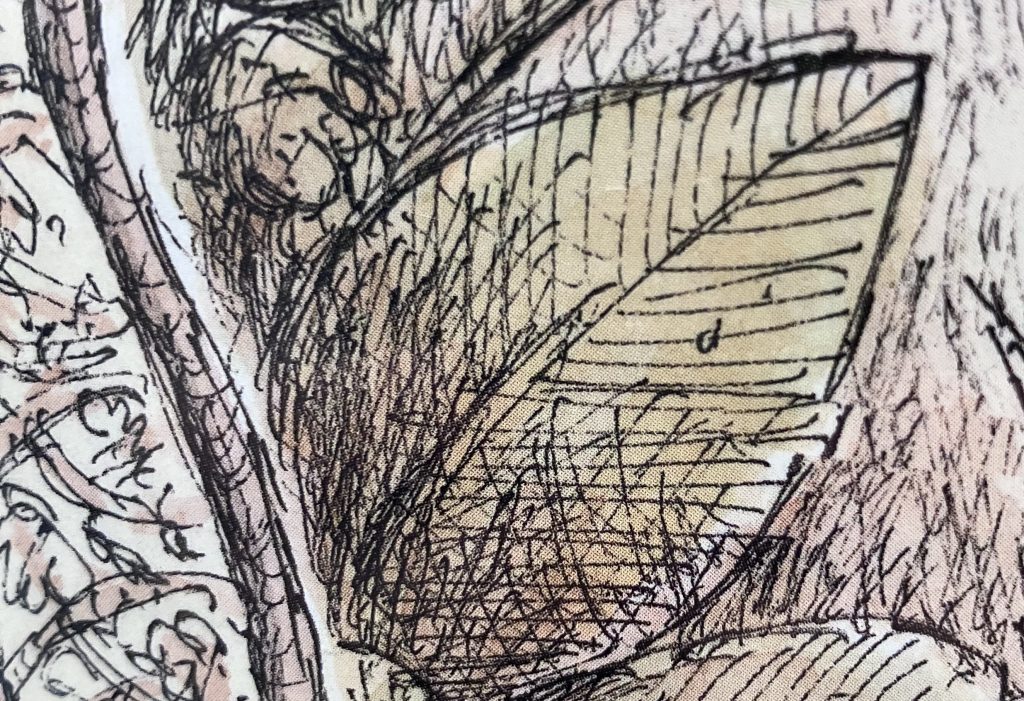
Ink pens produce a single color, most often black. However, “shades” can be introduced with the technique called hatching, which is a bunch of parallel lines. Cross hatching is when multiple sets of lines are drawn over each other going in different directions. The more hatching, the darker the drawing will look.
Above is a detail from the cover of Evergreen by Matthew Cordell. The black lines were drawn with an ink pen, while the green of the leaf and the pale brown accents are watercolor. Cordell uses a lot of short, thin pen lines to build up texture. Can you see how the leaf looks lighter on its tip and then darker towards the branch, as the amount of hatching increases?
Below is a detail from the cover of Honey by David Ezra Stein. He used a bamboo pen and watercolor in this image. Look at how the black lines are thick on the left end, when the nib held the most ink. As the pen drew to the right, the line thinned as the ink flow lessened. The wobble in the line is the natural result of a hand in motion. It is difficult to draw a perfectly smooth line in one stroke.
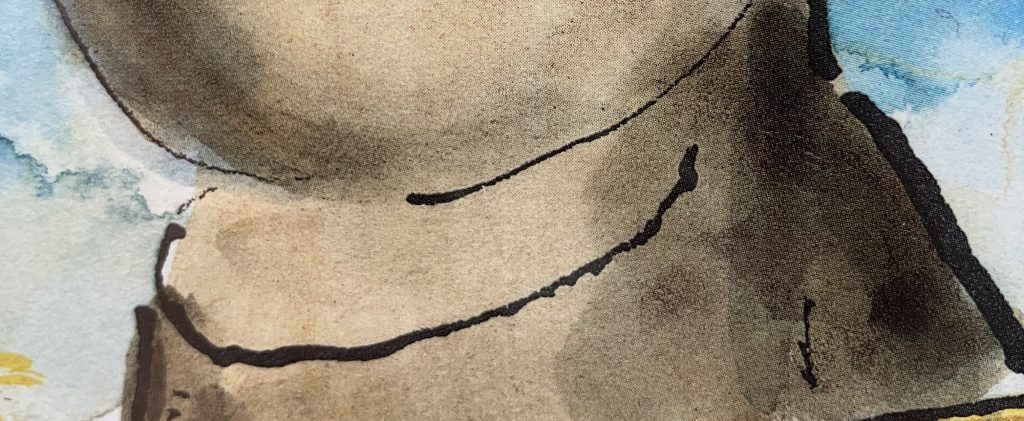
I love link lines like this! They are so fluid and bold and energetic! In my opinion, one of the greatest examples of the ink medium in picture books is One Cool Friend, by Tony Buzzeo (available through SearchOhio). David Small, the illustrator, has the best ink line I’ve ever seen. The book is mainly black and white, which makes Small’s linework the real star of the story.
Frequent Pairings
Pen and ink is exceptionally good at outlining because it creates a strong, consistent line. Permanent ink works well with watercolor, because areas can be filled in without smudging or causing the lines to bleed. Hand-drawn linework can be colored digitally, as well.
Read More


Pictured above: Evergreen by Matthew Cordell, Honey by David Ezra Stein, Every Peach is a Story by David Mas Masumoto and Nikiko Masumoto, The Nest that Wren Built by Randi Sonenshine, Papa’s Home by David Soman, Agent Lion by David Soman and Jacky Davis, ¡Vamos! by Raúl the Third, Building by Henry Cole, A Kiss for Akaraka by Richard Jackson, Road trip! by Steve Light, Owl Babies by Martin Waddell, Cloudy with a Chance of Meatballs by Judi Barrett,.